




MBA in Retail Management: Eligibility, Syllabus, Fees, Colleges & Career Scope
Retail today goes far beyond managing stores. It includes customer experience, merchandising, supply chains, e-commerce, branding, analytics, and…
Read More →

An MBA after B.Tech combines engineering fundamentals with management, finance and business strategy skills. It opens a new spectrum of career opportunities. Engineers pursue it to move from execution roles into product, consulting, operations, analytics or leadership positions. The route works for both fresh B.Tech graduates and experienced professionals seeking a career pivot.
Eligibility follows the standard MBA pattern with B.Tech-friendly quantitative weighting at most institutes. Exact criteria differ by university.
Work experience helps at premium institutes but is not mandatory across all colleges. UGC entitled online MBAs offer merit-based admission without entrance exams. Verify institute-specific requirements before applying, since criteria change each admission cycle.
B.Tech graduates typically clear one of the major national entrance exams for MBA admission. Acceptance varies by college and programme.
| Entrance Exam | Conducting Body |
| CAT | IIMs (rotational) |
| XAT | XLRI Jamshedpur |
| CMAT | NTA |
| MAT | AIMA |
| NMAT | GMAC |
| SNAP | Symbiosis International University |
| ATMA | AIMS |
| GMAT | GMAC |
Engineering graduates align well with quantitative and technology-adjacent MBA tracks. The table below maps specialisations to engineering profiles and career roles.
| Specialisation | Suitable Engineering Profile | Common Career Roles |
| Business Analytics | CSE, IT, ECE | Data analyst, analytics consultant, BI lead |
| IT and Technology Management | CSE, IT, Software | Technology consultant, IT manager, product owner |
| Operations Management | Mechanical, Production, Industrial | Operations manager, supply chain lead |
| Finance | Any engineering with quantitative strength | Financial analyst, investment banking associate |
| Marketing and Product Management | Any engineering | Product manager, brand manager, growth lead |
| Supply Chain Management | Mechanical, Industrial, Chemical | Supply chain manager, logistics head |
Full-time MBA programmes run for two years across four semesters. Executive MBAs run for 12 to 18 months at select institutes. Online MBAs at UGC-DEB-entitled providers run for two years with flexible pacing up to four years. Fees vary widely across formats. Full-time programmes at IIMs and top private institutes range from ₹15 to ₹25 lakh. Private university MBAs run at ₹3 to ₹10 lakh. UGC-entitled online MBAs cost ₹1.5 to ₹2.5 lakh with Zero Cost EMI at most providers.
Note: The cost can vary depending on institutes, courses, and other crucial factors.
The three routes serve different career vectors. The table below compares them across learning focus, career direction and time commitment.
| Parameter | MBA | M.Tech | Job |
| Learning Focus | Management, business, strategy | Deep technical, R and D | Applied skills through work |
| Duration | 2 years full-time | 2 years full-time | Immediate |
| Career Direction | Management, consulting, product | Senior technical, research, PhD | Domain-specific progression |
| Investment | ₹1.5 to ₹25 lakh | ₹1 to ₹5 lakh | None, salary from Day 1 |
| Suits | Career pivots, leadership goals | Technical depth, academic path | Direct income and applied learning |
Choose an MBA if you want a management or business-facing career. On the other hand, choose an M.Tech if you want deeper technical expertise or a research path. A job after the course gives you applied experience first, and you can pursue an MBA later. Two to three years of work experience often strengthens both MBA applications and outcomes.
MBA graduates with a B.Tech background enter roles that combine technical understanding with business acumen. Product companies, consulting firms and technology-driven startups value this hybrid profile.
Starting salaries vary by institute, sector and role. Premium institute MBAs typically start at ₹18 to ₹30 lakh, private university MBAs at ₹6 to ₹15 lakh, and UGC-entitled online MBAs at ₹5 to ₹12 lakh. Career progression depends on role fit, employer and continuous skill building.
An MBA after B.Tech is worth it when your goals point toward management, business or leadership roles. It works for engineers targeting product, consulting, strategy or entrepreneurship. It also fits professionals switching sectors or moving into business-facing positions within their current industry. It is less useful if you want to remain in deep technical roles, where an M.Tech or specialist certifications may deliver better value. Clarity on your five-year goal matters more than timing.
An MBA after B.Tech delivers strong value when the career vector points toward management, product or consulting. Match your specialisation to your engineering background and career goals. Verify fees, admissions and placement data on official pages, then apply to JIIT Online at admission.jiitonline.com for the online route.
Yes. Fresh B.Tech graduates are eligible for most MBA programmes. Work experience helps at premium institutes but is not universally mandatory.
It shapes your options but doesn't restrict them. CSE and IT branches fit analytics and technology tracks. Mechanical and Industrial fit operations. Any branch can pivot to finance or marketing.
Yes, at UGC-DEB-entitled providers. The online format works for candidates who want to work or intern alongside studies and save on tuition.
Yes. This is one of the most common post-MBA moves for engineers. Product, consulting and strategy firms actively hire engineers with MBAs.
Compare accreditation, curriculum depth, specialisation options, faculty, placement track record, fees, EMI options, and alumni network before finalising the college.

Retail today goes far beyond managing stores. It includes customer experience, merchandising, supply chains, e-commerce, branding, analytics, and…
Read More →
An MBA after B.Sc can be a strong next step if you want to combine your science background…
Read More →
Choosing an MBA after a BA can be a smart move if you want to shift from a…
Read More →
Want to earn an MBA without stepping away from your job or other responsibilities? The benefits of an…
Read More →
If you have completed MBBS and are wondering what else you could do beyond clinical practice, an MBA…
Read More →
If you are interested in how businesses trade, grow and build connections across countries, an MBA in Foreign…
Read More →
Choosing an MBA institute is a big decision because the college you pick can affect how you study,…
Read More →
Thinking about a career in real estate but not sure what the business side involves? An MBA Real…
Read More →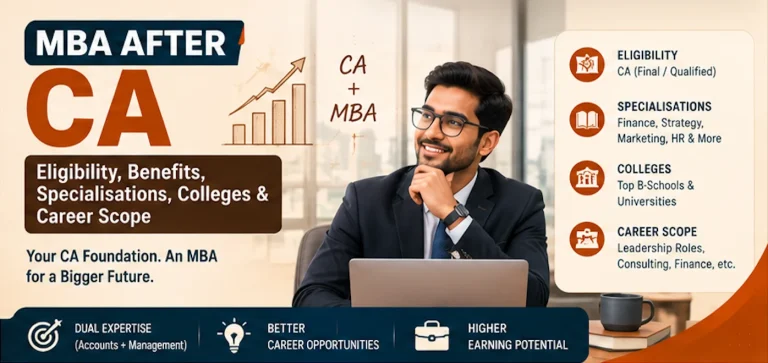
Completed CA and thinking about your next step? An MBA after CA can help you build management, strategy,…
Read More →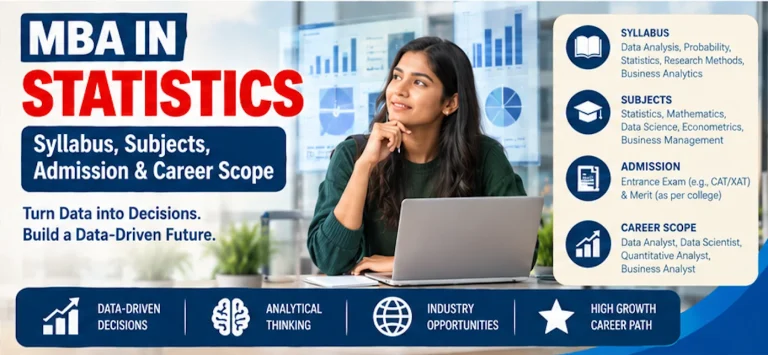
If you have a knack for numbers and enjoy understanding what data is telling you, MBA Statistics may…
Read More →