






MBA in Retail Management: Eligibility, Syllabus, Fees, Colleges & Career Scope
Retail today goes far beyond managing stores. It includes customer experience, merchandising, supply chains, e-commerce, branding, analytics, and…
Read More →
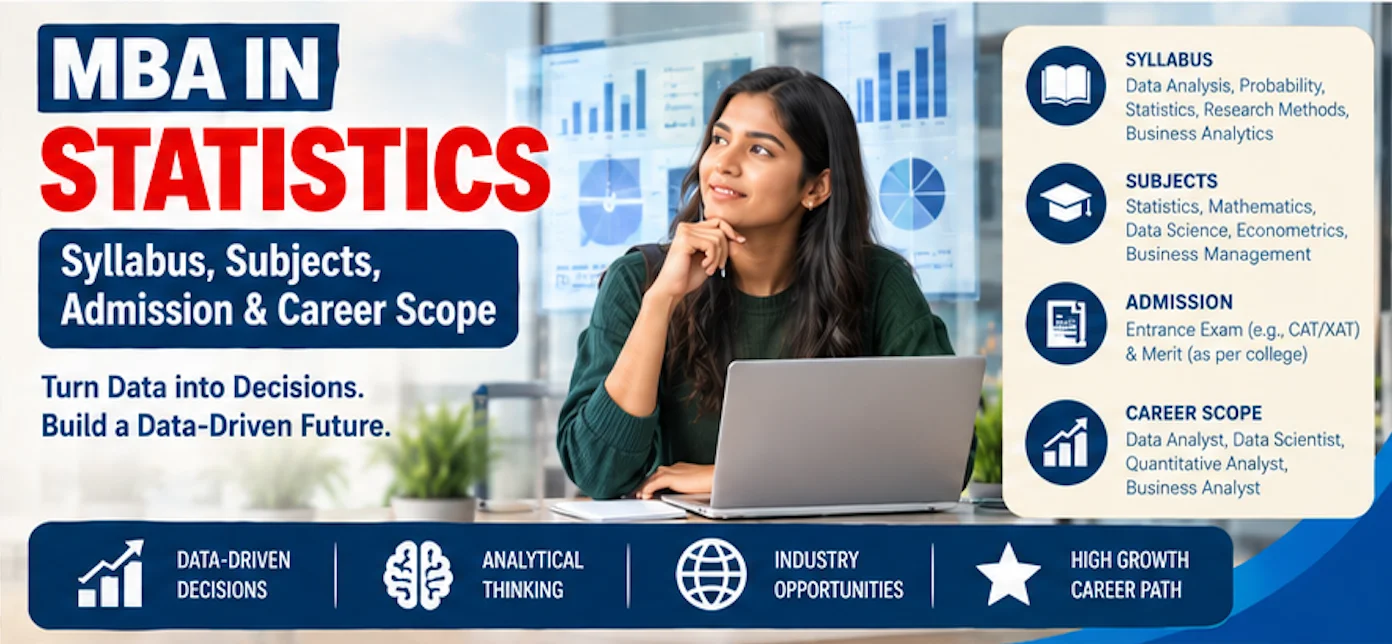
If you have a knack for numbers and enjoy understanding what data is telling you, MBA Statistics may be the right fit for you. Statistics in MBA teaches you how to read data, compare results, identify patterns and use evidence to support business decisions. These skills can be useful across areas such as marketing, finance, operations, and research. Knowing the subjects you will study, the skills you can build and the career options available can make it easier to decide whether this area fits your plans.
MBA in Statistics generally refers to management programmes with strong quantitative focus. It combines core MBA subjects with applied statistics for business decisions. Dedicated programmes may be titled Business Analytics, Data Analytics or Quantitative Management. The focus is on applied statistics for business rather than pure theoretical mathematics. Students learn to interpret data, test hypotheses, and build models that inform strategy. Graduates enter analytics, research, and consulting roles.
You usually do not need a Statistics degree to study Statistics in MBA. Eligibility depends on the MBA programme you choose. Common requirements may include:
Eligibility depends on the specific MBA programme and institution. UGC entitled online MBAs offer merit-based admission without an entrance test.
There is usually no separate admission process just for MBA Statistics because it is commonly part of the wider MBA curriculum. You first apply to the MBA programme or relevant quantitative specialisation.
Admission requirements and timelines differ, so check the latest details before applying.
The MBA Statistics syllabus usually starts with basic statistical concepts before moving to their use in business. Typical topics include:
| Topic / Unit | Key Concepts | Business Application |
| Introduction to Statistics | Data types, scales | Framing business problems |
| Measures of Central Tendency | Mean, median, mode | Summary reporting |
| Measures of Dispersion | Variance, standard deviation | Risk quantification |
| Probability | Rules, conditional probability | Uncertainty modelling |
| Probability Distributions | Normal, binomial, Poisson | Demand and defect analysis |
| Sampling and Central Limit Theorem | Sampling techniques | Market research |
| Estimation and Confidence Intervals | Point and interval estimates | Forecasting |
| Hypothesis Testing | Z, t, chi-square tests | A/B testing, quality control |
| Correlation | Pearson, Spearman | Relationship analysis |
| Regression Analysis | Simple, multiple regression | Predictive modelling |
| Time Series | Trend, seasonality, forecasting | Sales and demand forecasting |
| Non-parametric Tests | Mann-Whitney, Kruskal-Wallis | Small-sample analysis |
| Data Interpretation | Charts, tables, dashboards | Executive reporting |
MBA statistics coursework covers descriptive statistics, probability, inferential statistics and relationship analysis. The bullets below map the major concept areas students should master.
Concepts are typically taught with business cases and hands-on tool exposure. Software like Excel, SPSS, R and Python appear in advanced electives. Building fluency in these tools alongside statistical concepts creates strong analyst profiles.
Fees depend on university, programme format, institution type, location and duration. Premium institutes charge ₹15 to 25 lakh total. Private universities range from ₹5 to 12 lakh. UGC-DEB-entitled online MBAs cost ₹1.5 to 2.5 lakh, with Zero Cost EMI options. Additional expenses include entrance exam fees, application fees and study materials. Verify current tuition on the institute’s admissions page before applying.
Statistics can be useful in any role where you need to understand data and use it to make business decisions. Depending on your MBA specialisation, skills and experience, you may explore roles such as:
Studying Statistics alone does not decide your career path. It works best as a supporting skill alongside areas such as marketing, finance, operations or Business Analytics. Building confidence with data tools can also help if you want to move into more analytical roles..
MBA Statistics can make business data easier to understand and use. From analysing customer behaviour to forecasting demand, statistical thinking can support decisions across different business functions. If you enjoy working with data, you can also look at MBA programmes that offer Business Analytics or other quantitative subjects. Apply to JIIT Online at admission.jiitonline.com for a UGC entitled MBA with Business Analytics electives.
Descriptive statistics, probability, distributions, sampling, hypothesis testing, correlation, regression, time series and non-parametric tests applied to business decisions.
Difficulty depends on prior quantitative background. Applied MBA statistics focuses on business context rather than theoretical proofs, making it manageable with practice.
Basic algebra and arithmetic are sufficient. Advanced maths is not required for MBA statistics coursework at most institutes.
Statistics covers conceptual foundations of data analysis. Business Analytics extends statistics with tools, modelling and applied projects for business decisions.
Excel, SPSS, R, Python, Tableau and Power BI are commonly taught. Excel remains the foundation across all MBA programmes.
Fees range from ₹1.5 lakh at UGC entitled online providers to ₹25 lakh at premium regular MBAs. Private universities sit between the two.

Retail today goes far beyond managing stores. It includes customer experience, merchandising, supply chains, e-commerce, branding, analytics, and…
Read More →
An MBA after B.Sc can be a strong next step if you want to combine your science background…
Read More →
Choosing an MBA after a BA can be a smart move if you want to shift from a…
Read More →
An MBA after B.Tech combines engineering fundamentals with management, finance and business strategy skills. It opens a new…
Read More →
Want to earn an MBA without stepping away from your job or other responsibilities? The benefits of an…
Read More →
If you have completed MBBS and are wondering what else you could do beyond clinical practice, an MBA…
Read More →
If you are interested in how businesses trade, grow and build connections across countries, an MBA in Foreign…
Read More →
Choosing an MBA institute is a big decision because the college you pick can affect how you study,…
Read More →
Thinking about a career in real estate but not sure what the business side involves? An MBA Real…
Read More →
Completed CA and thinking about your next step? An MBA after CA can help you build management, strategy,…
Read More →