





MBA in Retail Management: Eligibility, Syllabus, Fees, Colleges & Career Scope
Retail today goes far beyond managing stores. It includes customer experience, merchandising, supply chains, e-commerce, branding, analytics, and…
Read More →

An MBA after B.Sc can be a strong next step if you want to combine your science background with business and management skills. Your B.Sc may already give you analytical thinking, problem-solving ability, and subject knowledge, while an MBA can open pathways into management, consulting, healthcare, analytics, marketing, finance, operations, and other business roles. The key is choosing a specialisation that matches both your interests and long-term career goals. Before applying, it helps to understand the eligibility criteria, entrance requirements, course fees, available specialisations, and the kind of career opportunities you can realistically expect after completing the programme.
Yes, you can pursue an online MBA after completing a B.Sc. In fact, a science background can work in your favour because it already gives you strong analytical, logical, and problem-solving skills.
Graduates from streams such as Computer Science, Physics, Chemistry, Biology, Mathematics, and Biotechnology can apply for MBA programmes, subject to the institute’s eligibility criteria.
With JIIT Online, an MBA can help you build on your science background while adding skills in management, finance, marketing, strategy, and leadership. This combination can open opportunities in consulting, analytics, healthcare, technology, operations, product management, and other business-focused roles.
B.Sc graduates pursue an MBA for several career-shaping reasons. The choice depends on the individual’s five-year goals and interests.
The MBA route works well for B.Sc graduates who want to move beyond bench work or technical execution. It also suits candidates targeting management roles in science-intensive sectors like pharma, biotech and healthcare. Match your specialisation choice to your B.Sc background and career direction.
Eligibility follows the standard MBA framework with no stream-based restrictions. Institute-specific criteria vary and should be verified on official pages.
Work experience is preferred at premium institutes but not universally mandatory. UGC-DEB-entitled online MBAs offer merit-based admission without an entrance exam. Confirm exam acceptance and cut-offs for each institute before applying.
B.Sc graduates take the same national entrance exams as other MBA applicants. Acceptance varies by college.
| Entrance Exam | Conducting Body |
| CAT | IIMs (rotational) |
| XAT | XLRI Jamshedpur |
| MAT | AIMA |
| CMAT | NTA |
| NMAT | GMAC |
| SNAP | Symbiosis International University |
B.Sc backgrounds align well with quantitative and domain-specific MBA specialisations. The table below maps common B.Sc streams to suitable MBA tracks and career areas.
| B.Sc Background | Suitable MBA Specialisation | Career Area |
| B.Sc Computer Science / IT | Business Analytics, IT Management | Data analytics, technology consulting, product |
| B.Sc Mathematics / Statistics | Business Analytics, Finance | Analytics, risk, quantitative finance |
| B.Sc Physics | Operations, Analytics, Finance | Operations research, analytics, consulting |
| B.Sc Chemistry | Operations, Supply Chain, Pharma Management | Pharma operations, supply chain, sales |
| B.Sc Biology / Biotechnology | Healthcare Management, Pharma Management | Hospital admin, pharma marketing, biotech operations |
| B.Sc Economics | Finance, Economics, Business Analytics | Investment banking, analytics, research |
| B.Sc Nursing / Life Sciences | Healthcare Management | Hospital administration, health services management |
MBA programmes cover a common core of management subjects across all specialisations. Core subjects include management principles, financial accounting, marketing management, human resource management, operations management, business statistics, managerial economics and business strategy. Electives cover the chosen specialisation, such as analytics, finance, marketing or healthcare management. Most programmes include a capstone project and internship in the final year. The exact syllabus varies by specialisation and university, so verify curriculum documents before enrolling.
Fees vary widely across programme types. Premium institute MBAs cost ₹15 to ₹25 lakh. Private university MBAs range from ₹3 to ₹10 lakh. UGC-DEB-entitled online MBAs sit at ₹1.5 to ₹2.5 lakh with Zero Cost EMI options. Verify current tuition on each institute’s admissions page before applying.
The table below covers institutes offering MBA programmes suitable for B.Sc graduates across delivery modes. Selection considers accreditation, curriculum, placement outcomes and delivery flexibility.
| College / University | MBA Programme | Entrance Route | Mode | Key Feature |
| IIM Bangalore | PGP with analytics track | CAT | On-campus | Analytics electives and research centres |
| ISB Hyderabad | PGP | GMAT / GRE | On-campus | One-year immersive format |
| NMIMS Mumbai | MBA with Business Analytics | NMAT | On-campus | Strong industry connect |
| Symbiosis (SCMHRD) | MBA Business Analytics | SNAP | On-campus | Analytics-focused curriculum |
| JIIT Online | Online MBA with Business Analytics track | Merit-based | Online | ₹1,75,000 with Zero Cost EMI |
B.Sc graduates with an MBA enter management roles across technology, healthcare, finance, consulting, operations and marketing sectors. Domain knowledge from the B.Sc becomes a differentiator in science-intensive industries.
Starting salaries range from ₹5 to ₹20 lakh depending on institute, sector and role. Analytics and consulting tracks pay above the median for B.Sc graduates with strong quantitative skills. Match your career vector to a specialisation that builds on your B.Sc strengths for the best return on investment.
An MBA after B.Sc combines scientific analysis with structured business training, opening management and leadership careers across sectors. Match your specialisation to your B.Sc background and career goals, then verify fees and admissions on official pages. Apply to JIIT Online at admission.jiitonline.com to explore its UGC entitled online MBA options.
Yes. It combines scientific analysis skills with business training, opening management roles across BFSI, consulting, healthcare, technology and pharma.
A three-year B.Sc degree with 50% aggregate marks and a valid entrance exam score is required at most institutes. Merit-based admission is available at UGC entitled online providers.
The fit depends on your B.Sc stream. Analytics and IT Management suit computer science; healthcare management suits biology, and biotech suits maths and statistics.
Yes. Most MBA programmes accept fresh B.Sc graduates. Work experience helps at premium institutes but is not universally mandatory.
MBA suits management, business or consulting careers. MSc suits deeper technical, research or academic paths. Choose based on your five-year career vector.
CAT, XAT, MAT, CMAT, NMAT, SNAP and GMAT are the primary options. Merit-based admission is available at UGC entitled online MBA providers.

Retail today goes far beyond managing stores. It includes customer experience, merchandising, supply chains, e-commerce, branding, analytics, and…
Read More →
Choosing an MBA after a BA can be a smart move if you want to shift from a…
Read More →
An MBA after B.Tech combines engineering fundamentals with management, finance and business strategy skills. It opens a new…
Read More →
Want to earn an MBA without stepping away from your job or other responsibilities? The benefits of an…
Read More →
If you have completed MBBS and are wondering what else you could do beyond clinical practice, an MBA…
Read More →
If you are interested in how businesses trade, grow and build connections across countries, an MBA in Foreign…
Read More →
Choosing an MBA institute is a big decision because the college you pick can affect how you study,…
Read More →
Thinking about a career in real estate but not sure what the business side involves? An MBA Real…
Read More →
Completed CA and thinking about your next step? An MBA after CA can help you build management, strategy,…
Read More →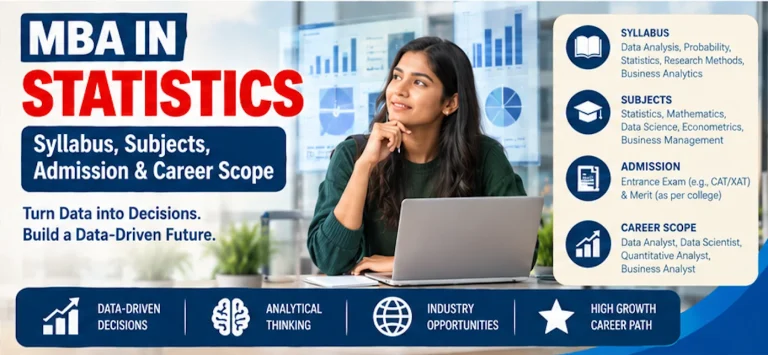
If you have a knack for numbers and enjoy understanding what data is telling you, MBA Statistics may…
Read More →