



MBA in AI for Business Course Details, Admission, Eligibility
Artificial intelligence is changing how organisations forecast demand, personalise customer journeys, manage risk and automate decisions. An MBA…
Read More →
The demand for professionals who can combine management insight with strong analytical abilities is rising rapidly, and many learners are now considering programs like a PGDM in Business Analytics as organisations continue to value greater data-driven skills. At the same time, the flexibility of an online MBA program appeals to those who want a broader business foundation with the option to strengthen their analytical capabilities through pathways such as an online MBA in Business Analytics.
In this article, we walk through the key differences between these two learning routes so you can make a choice that aligns with your goals and opens opportunities in an increasingly data-centric business world.
This course is designed for learners who want to build strong analytical and decision-making capabilities, and it prepares students to work with data, interpret insights, and support business strategies in fast-moving industries. This program places a strong emphasis on practical tools, data handling, and real-world problem-solving, making it a suitable choice for those aiming for analytics-driven management roles.
| Aspect | Details |
| Definition and Purpose | A postgraduate diploma aimed at developing advanced analytical, managerial, and problem-solving skills |
| Core Focus Areas | Analytical tools, data modelling, predictive analysis, business intelligence, and data-driven decision frameworks |
| Industry Relevance | Highly valued in sectors like consulting, finance, retail, technology, and operations where analytics informs strategic decisions |
| Decision factor | PGDM in Business Analytics | Online MBA in Business Analytics |
|---|---|---|
| Primary purpose | Build applied analytics and tool depth | Combine analytics with wider management capability |
| Best suited to | Early-career learners or career switchers seeking hands-on analytics roles | Working professionals aiming to move from analysis into business ownership or management |
| Typical learning emphasis | Python, SQL, visualisation, statistics and domain projects, depending on the institute | Analytics plus finance, marketing, operations, strategy and leadership |
| Delivery pattern | May be full-time, executive, weekend or online | Designed for online delivery with live and recorded learning |
| Credential | Diploma awarded by an autonomous institute | University degree, subject to the university and programme holding the required recognition |
| Career interruption | Often required for full-time programmes | Usually not required |
| Decision risk | Choosing a programme that is too technical for a management goal | Choosing a programme that lacks enough practical analytics exposure |
Understanding how the curriculum differs can help you identify which pathway matches your learning needs because both PGDM and online MBA in Business Analytics offer unique academic strengths that shape your expertise.
| Curriculum Area | PGDM in Business Analytics | Online MBA in Business Analytics |
| Core Focus | Data analytics, machine learning fundamentals, predictive modelling, business intelligence tools | Core MBA subjects, analytics electives, decision-making frameworks, data-driven strategy |
| Academic Style | More technical with stronger emphasis on tools and hands-on analytics | More managerial with analytics integrated into business strategy |
| Learning Approach | Practical sessions, lab work, tool mastery, real datasets | Conceptual learning, strategic application, case studies |
| Skill Orientation | Technical depth for analytics-centric roles | Balanced skills combining management knowledge with analytical thinking |
A useful comparison is not how many subjects each programme lists, but what responsibilities those subjects can help you handle.
For Karan, this route may be useful if he still depends on others for data preparation, querying, visualisation or model building. A practice-heavy PGDM could help him become more independent in technical analytics work, provided the institute offers credible projects and sufficient tool exposure.
If Karan can already work with reports but struggles to explain revenue impact, customer behaviour, cost trade-offs or strategic priorities, management subjects become more important. Finance, marketing, operations and strategy can help him connect an analytical finding with a business recommendation.
A programme can improve capability and credibility, but it does not automatically create a promotion. Karan would still need to apply the learning through projects, workplace initiatives, a stronger portfolio and clearer communication with decision-makers.
| Target responsibility | What you need to develop | Likely better fit |
| Build dashboards, queries and analytical models | Technical practice, data tools and repeated project execution | A tool-intensive PGDM or analytics programme |
| Translate data into recommendations | Business context, problem framing and communication | Online MBA with strong analytics application |
| Manage analysts or cross-functional projects | Leadership, finance, strategy and stakeholder management | Online MBA |
| Make a complete career switch into analytics | Foundational technical training plus portfolio evidence | PGDM may fit, depending on format and depth |
| Progress while continuing a full-time job | Flexible delivery and immediate workplace application | Online MBA |
For a professional like Karan, JIIT Online may be worth evaluating when the goal is to continue working while building broader management judgement around analytics. Its MBA pathway is positioned around IT and Business Analytics rather than a stand-alone PGDM. That distinction matters because the learner is not only studying data; the learner is preparing to use data in finance, marketing, operations and strategic decisions.
The programme should be judged on four points: whether the current curriculum provides enough hands-on analytics exposure, whether live and recorded delivery fits the learner’s schedule, whether the fee is manageable, and whether the degree supports the learner’s intended career or higher-study path. Programme-specific claims, including fee, eligibility, approvals, curriculum and career services, should be confirmed from the latest official JIIT Online sources before enrolment.
| Checkpoint | PGDM | Online MBA |
| Bachelor’s degree | Generally required; minimum marks vary | Generally required; minimum marks vary |
| Entrance test | May be required by full-time or selective institutes | Many online programmes use merit-based admission, but policies differ |
| Work experience | May be preferred or mandatory for executive formats | May not be mandatory for standard online MBA programmes |
| Age limit | Usually no general upper limit, subject to institute rules | Usually no general upper limit, subject to university rules |
| Documents | Academic records, identity proof and programme-specific documents | Academic records, identity proof and programme-specific documents |
Published fee ranges can be misleading because programme duration, delivery, campus access and included services vary widely. Karan should compare the total payable fee, the income he may give up for a full-time programme, travel or relocation costs, and the amount of time available for projects and networking.
For a working professional, the lower opportunity cost of an online programme may be valuable. For someone making a complete technical career switch, a more intensive full-time programme may justify a higher cost. Return should therefore be measured by the responsibilities the programme can help the learner pursue, not by an assumed salary increase.
Karan does not need another credential simply to add a line to his resume. He needs a programme that helps him move from preparing analysis to influencing business action. If his main gap is technical execution, a rigorous PGDM may be the more direct route. If he already understands data but needs wider management judgement, leadership capability and the flexibility to keep working, an Online MBA may fit better.
JIIT Online can be considered by professionals who want to combine analytics with management learning without pausing their careers. The final decision should follow a review of the current curriculum, eligibility, fee, delivery schedule and learner support. A counsellor discussion is most useful when the learner arrives with a target role and asks exactly how the programme supports that transition.
Neither is universally better. A PGDM may provide more concentrated technical practice, while an Online MBA may provide broader management learning and greater flexibility. The right choice depends on the learner’s current skills and next-role objective.
Yes, when the institute offers an executive, weekend or online format. Full-time PGDM programmes may require a career break, so the weekly schedule and attendance expectations should be checked before applying.
An Online MBA may be more relevant when the learner already has analytical exposure and needs strategy, finance, leadership and stakeholder-management skills. Technical depth must still be assessed in the actual curriculum.
A practice-intensive PGDM or another technical analytics programme may be more suitable when the learner needs stronger foundations in data tools, statistics and portfolio projects.
Placement support depends on the institute, programme format and learner category. Full-time PGDM programmes may offer structured campus recruitment, while online programmes may focus on career services, job portals, mentoring or selected placement support. Verify what is available to the specific cohort.
A university MBA is a degree, while a PGDM is a diploma. Recognition requirements can vary by employer, regulator or higher-education institution, so candidates should confirm the rules relevant to their intended application.
The source document describes JIIT Online as offering an MBA pathway with an IT and Business Analytics specialisation rather than a PGDM. The latest programme title, curriculum and admission details should be confirmed on the official programme page.
Compare curriculum depth, projects, delivery schedule, faculty interaction, recognition, fee, learner support and the exact career services provided to your programme format.

Artificial intelligence is changing how organisations forecast demand, personalise customer journeys, manage risk and automate decisions. An MBA…
Read More →
An MBA in Business Management is useful for learners who want broad management capability before committing deeply to…
Read More →
For professionals and graduates interested in cross-border markets, trade, global strategy or multinational operations, an MBA in International…
Read More →
An MBA in Sports Management can suit learners who want to work on the business side of sport…
Read More →
An MBA in Entrepreneurship helps learners understand how ideas become viable businesses, how ventures are financed and how…
Read More →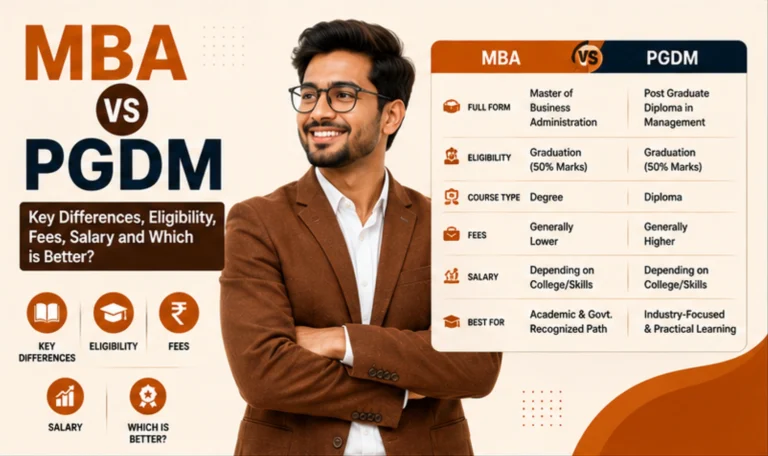
MBA vs PGDM at a glance: An MBA is a university-awarded postgraduate degree, while a PGDM is a…
Read More →
Priya is a 30-year-old marketing operations professional. She prepares campaign reports, tracks conversion numbers and works with dashboards…
Read More →
Move from coordinating tasks to leading projects that shape business outcomes Aman is a 29-year-old site engineer with…
Read More →
You have probably reached a familiar point. Perhaps you have three or four years of work experience and…
Read More →
A practical comparison framework for prospective students evaluating recognised online MBA programmes in India. The right online MBA…
Read More →