







MBA in Retail Management: Eligibility, Syllabus, Fees, Colleges & Career Scope
Retail today goes far beyond managing stores. It includes customer experience, merchandising, supply chains, e-commerce, branding, analytics, and…
Read More →
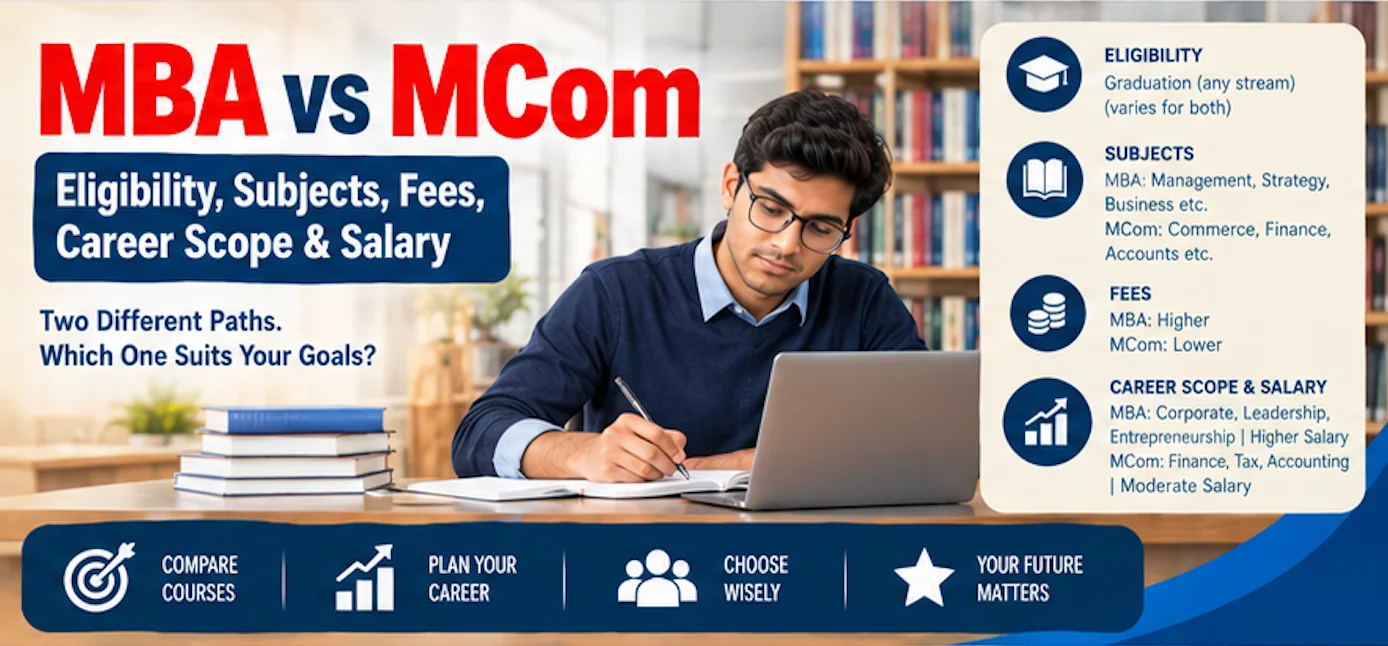
If you have finished graduation and are confused about MBA vs MCom, start by looking at how these two courses differ. Both are postgraduate degrees and can lead to a range of career options. MBA takes a broader business and management approach, while MCom focuses more deeply on commerce-related studies. Understanding the difference between MBA and MCom can help you compare learning style, career possibilities, and future study options before deciding what suits you best.
The two degrees serve different career goals. The table below covers the primary comparison points.
| Factor | MBA | MCom |
| Full Form | Master of Business Administration | Master of Commerce |
| Degree Type | Postgraduate professional degree | Postgraduate academic degree |
| Primary Focus | Management, leadership, strategy | Commerce, accounting, taxation |
| Eligibility | Any bachelor’s with 50% | Bachelor’s in commerce or related |
| Typical Duration | 2 years | 2 years |
| Curriculum | Broad management functions | Deep commerce and accounting |
| Specialisations | Wide range across functions | Accounting, finance, taxation focus |
| Entrance Requirements | CAT, XAT, CMAT, GMAT | University-level or merit-based |
| Skills Developed | Leadership, strategy, decision-making | Accounting, taxation, financial analysis |
| Career Opportunities | Management, consulting, corporate | Accounting, taxation, banking, teaching |
| Suitable Candidates | Management-oriented graduates | Commerce and accounting-focused graduates |
| Higher-Study Options | PhD, doctoral research | MPhil, PhD, CA integration |
Eligibility is one of the clearest differences in the MCom vs MBA comparison. MBA programmes usually accept graduates from any discipline, while MCom is more commonly chosen by students with a commerce, economics or finance background.
| Eligibility Factor | MBA | MCom |
| Bachelor’s Degree | Any discipline | BCom or commerce-related preferred |
| Preferred Background | All disciplines welcome | Commerce, economics, finance |
| Minimum Marks | 50% aggregate | 50% aggregate |
| Entrance Examinations | CAT, XAT, CMAT, MAT, NMAT, SNAP | University tests or merit-based |
| Work Experience | Preferred at premium institutes | Not required |
| University-Specific | Varies by institute | Varies by university |
For JIIT Online’s MBA, applicants need a recognised bachelor’s degree and must meet the programme’s current admission criteria. If you are planning to apply, check the latest mba course eligibility details on the official JIIT Online admissions page before submitting your application.
MBA covers a wider mix of management subjects, while MCom stays closer to commerce, finance and accounting.
If you enjoy strategy, marketing, leadership or managing teams, an MBA may suit you better. If accounting, taxation and finance interest you more, MCom may feel like the more natural fit.
MBA admissions often involve national or institute-level entrance exams, while MCom admissions are usually merit-based or conducted through university entrance tests.
Admission timelines vary by institution, so check the university’s official schedule before applying.
Cost can make a big difference when choosing MBA or MCom. MBA at premium institutes costs ₹15 to 25 lakh. Private university MBAs run at ₹3 to 10 lakh. Online MBAs at UGC-DEB-entitled providers sit at ₹1.5 to 2.5 lakh. MCom fees are significantly lower. Government universities charge ₹10,000 to 30,000 per year. Private universities charge ₹30,000 to 1,00,000 per year. Both require additional application, examination, and study material costs.
The two degrees open different career paths. The lists below cover typical career areas and roles.
MBA starting salaries range from ₹6 to 30 lakh depending on the institute. MCom starting salaries range from ₹3 to 8 lakh at entry level. MBA typically offers stronger salary progression over the mid-career horizon.
If you are wondering which is better, MBA or MCom, start with the kind of work you want to do and the subjects you enjoy.
Speak to alumni from both degrees before finalising your choice. Match the programme to career goals rather than peer choices. Both degrees offer strong outcomes when paired with the right institute and prior experience.
The MBA vs MCom choice becomes easier when you know whether you want broader management exposure or deeper commerce knowledge. MBA suits students looking towards leadership, business and management roles, while MCom is more focused on accounting, taxation and finance. If an online MBA fits your plans, you can explore JIIT Online’s UGC-entitled MBA at ₹1,75,000 with Zero Cost EMI at admission.jiitonline.com.
Yes. BCom is one of the most common undergraduate backgrounds for MBA admission. Most institutes accept BCom graduates with 50% aggregate marks.
Neither is universally better. MBA suits management and leadership careers. MCom suits accounting, taxation and finance careers. Choose based on your five-year career vector.
MCom builds deeper knowledge in accounting and taxation. MBA Finance builds broader corporate finance and management skills. Choose based on the specific finance career you target.
MBA opens broader management careers across functions. MCom offers focused careers in accounting, taxation and banking. Career scope depends on the individual's vector.
MBA typically offers higher starting salaries and stronger progression, especially at premium institutes. MCom salaries are more modest but stable in accounting and banking careers.
Yes. MBA admits graduates from any discipline, including engineering, arts, science and commerce. BCom is not a prerequisite for MBA admission.
Yes. MCom is well regarded for banking, accounting, taxation, and financial services roles. It also prepares candidates for CA, CS and CFA integration.
Yes. Many MCom graduates pursue CA in parallel or after completion. The commerce foundation supports the CA curriculum effectively.
An MBA opens broader career paths and offers higher salary potential. MCom deepens commerce expertise for accounting-focused careers. Choose based on your long-term goals.
Yes. Both degrees are eligible for PhD admission at UGC-recognised universities, subject to entrance exams and research proposals.

Retail today goes far beyond managing stores. It includes customer experience, merchandising, supply chains, e-commerce, branding, analytics, and…
Read More →
An MBA after B.Sc can be a strong next step if you want to combine your science background…
Read More →
Choosing an MBA after a BA can be a smart move if you want to shift from a…
Read More →
An MBA after B.Tech combines engineering fundamentals with management, finance and business strategy skills. It opens a new…
Read More →
Want to earn an MBA without stepping away from your job or other responsibilities? The benefits of an…
Read More →
If you have completed MBBS and are wondering what else you could do beyond clinical practice, an MBA…
Read More →
If you are interested in how businesses trade, grow and build connections across countries, an MBA in Foreign…
Read More →
Choosing an MBA institute is a big decision because the college you pick can affect how you study,…
Read More →
Thinking about a career in real estate but not sure what the business side involves? An MBA Real…
Read More →
Completed CA and thinking about your next step? An MBA after CA can help you build management, strategy,…
Read More →