




MBA in Retail Management: Eligibility, Syllabus, Fees, Colleges & Career Scope
Retail today goes far beyond managing stores. It includes customer experience, merchandising, supply chains, e-commerce, branding, analytics, and…
Read More →
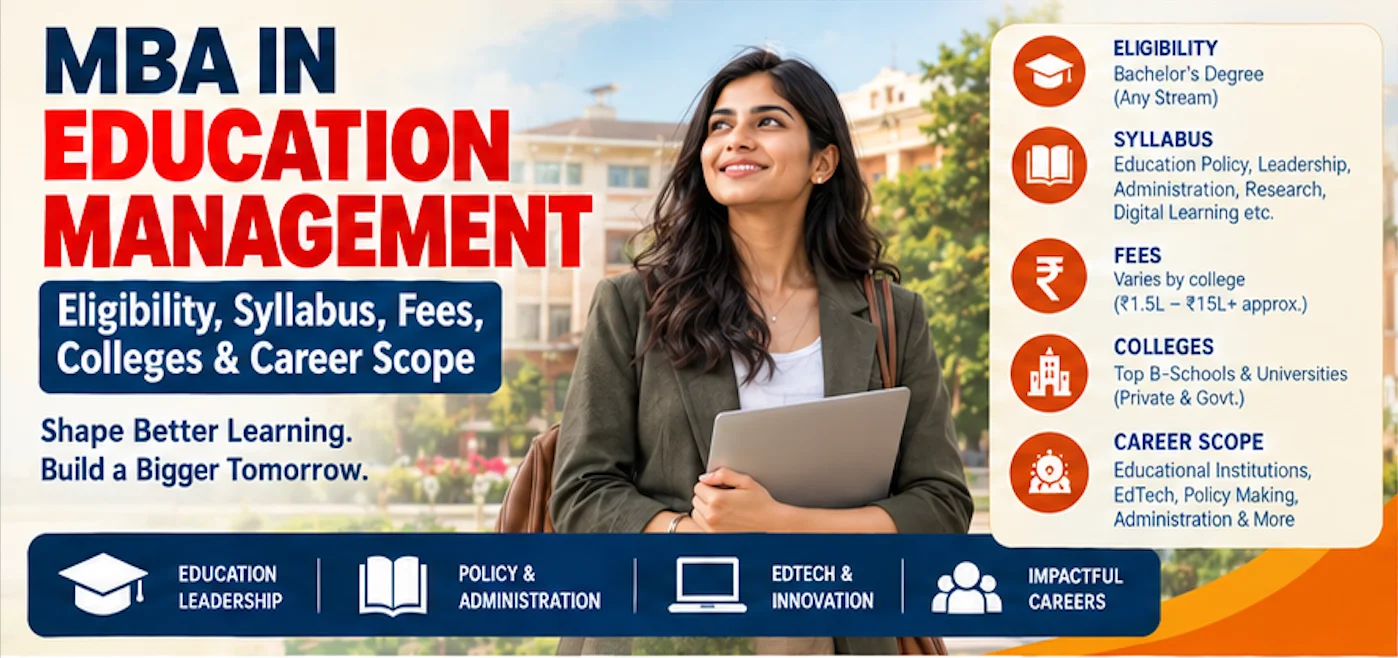
Want to build a career in the education sector beyond teaching? An MBA in Education Management can help you move into roles where you manage teams, handle operations, and support how schools, colleges, or education companies are run. The programme combines business skills with areas such as education policy, technology and administration, opening opportunities across schools, colleges, EdTech companies and education consulting.
An MBA in Education Management is a postgraduate degree that focuses on how educational organisations are planned, managed and improved. You learn about areas such as budgeting, people management, operations, technology and institutional planning. The course can help you understand how decisions are made across schools, colleges and other education-focused organisations. It also gives you a broader view of how academic and administrative teams work together. Some universities may use names such as MBA in Education Administration for similar programmes.
This degree can open up different career paths, depending on your interests and previous experience. An MBA in Education Management offers career benefits that combine management training with sector-specific expertise. Career opportunities include:
The programme suits candidates already in education wanting a leadership pathway. Consider where you want your career to go, then choose a specialisation that supports that path.
The eligibility requirements are similar to those of many MBA programmes, although individual institutes may have their own criteria.
| Eligibility Factor | Typical Requirement |
| Educational Qualification | Bachelor’s degree in any discipline |
| Minimum Marks | 50% aggregate (45% for reserved categories) |
| Work Experience | Preferred at premium institutes; helpful for education sector roles |
| Entrance Examination | CAT, XAT, CMAT, MAT, NMAT or SNAP |
| Selection Process | Exam score plus GD or interview at premium institutes |
| Documents Required | 10th, 12th, graduation marksheets, ID proof, photograph |
UGC-DEB-entitled online MBAs program offer merit-based admission without an entrance exam. IGNOU offers a dedicated MBA in Education Management with periodic intake cycles. Check the latest eligibility criteria and application deadlines before applying.
Once you choose a program, the application usually involves a few straightforward steps. Follow these steps to apply successfully.
The process takes 4 to 6 weeks at premium institutes and 7 to 15 days at UGC entitled online providers. IGNOU follows fixed January and July intake cycles.
The syllabus combines core MBA subjects with topics that are specific to the education sector. The table below maps subjects to key topics.
| Subject / Area | Key Topics Covered |
| Principles of Management | Planning, organising, staffing, controlling |
| Educational Administration | School and college administration, governance |
| Education Planning | Curriculum planning, resource allocation, academic calendar |
| Education Policy | National Education Policy, regulatory frameworks |
| Leadership in Education | Institutional leadership, change management |
| Financial Management | Budgeting, fee structures, institutional finance |
| Human Resource Management | Faculty recruitment, training, retention |
| Marketing Management | Admissions marketing, branding, positioning |
| Operations Management | Academic operations, examinations, evaluations |
| Strategic Management | Institutional strategy, competitive positioning |
| Educational Technology | LMS, digital learning, EdTech integration |
| Quality Management | NAAC, accreditation, quality assurance |
| Institutional Development | Capacity building, infrastructure planning |
| Entrepreneurship | Starting schools, coaching centres and EdTech ventures |
| Education Research / Analytics | Learning analytics, data-driven decisions |
Fees depend on university, programme mode, duration, facilities and delivery model.
| Programme Type | Indicative Fee Range (Rs.) |
| Full-time MBA (Premium) | 8,00,000 to 20,00,000 |
| Online MBA (UGC-DEB entitled) | 1,50,000 to 2,50,000 |
| IGNOU MBA (Education Management) | 60,000 to 90,000 approx. |
| Distance / ODL MBA | 50,000 to 1,50,000 |
The degree is not limited to school administration. You can explore roles across different parts of the education sector. Graduates enter leadership, administration and consulting roles across schools, colleges, EdTech firms and education NGOs.
Starting salaries range from ₹5 to 15 lakh depending on institution and role. EdTech firms typically pay above traditional schools. Senior leadership roles cross ₹25 lakh with 8 plus years of experience.
If you want to build a career in education beyond the classroom, an MBA in Education Management can help you explore roles in administration, operations and leadership. Before applying, think about the kind of work you see yourself doing and choose a programme that matches your goals, budget and study preferences. Apply to JIIT Online at admission.jiitonline.com for the online route.
Educational administration, education planning, education policy, leadership in education, educational technology and quality management alongside core MBA subjects.
Yes, for professionals targeting leadership roles in schools, colleges, EdTech firms and education consulting. Growth in EdTech and organised education continues to expand hiring.
Yes, at UGC-DEB-entitled providers. IGNOU offers a dedicated MBA in Education Management, while other providers cover it as an elective within general MBA programmes.
Starting salaries range from ₹5 to ₹15 lakh depending on institution type. EdTech and premium school groups typically pay above the median.
Preferred at premium institutes but not universally mandatory. Education sector experience helps in placements but is not required for admission at most providers.
Education Management focuses on strategic and operational leadership. Education Administration focuses on day-to-day operations, compliance, and student services within an institution.
Yes. A bachelor's degree in any discipline is accepted with a 50% aggregate. Prior teaching or education sector experience helps but is not mandatory.

Retail today goes far beyond managing stores. It includes customer experience, merchandising, supply chains, e-commerce, branding, analytics, and…
Read More →
An MBA after B.Sc can be a strong next step if you want to combine your science background…
Read More →
Choosing an MBA after a BA can be a smart move if you want to shift from a…
Read More →
An MBA after B.Tech combines engineering fundamentals with management, finance and business strategy skills. It opens a new…
Read More →
Want to earn an MBA without stepping away from your job or other responsibilities? The benefits of an…
Read More →
If you have completed MBBS and are wondering what else you could do beyond clinical practice, an MBA…
Read More →
If you are interested in how businesses trade, grow and build connections across countries, an MBA in Foreign…
Read More →
Choosing an MBA institute is a big decision because the college you pick can affect how you study,…
Read More →
Thinking about a career in real estate but not sure what the business side involves? An MBA Real…
Read More →
Completed CA and thinking about your next step? An MBA after CA can help you build management, strategy,…
Read More →