





MBA in AI for Business Course Details, Admission, Eligibility
Artificial intelligence is changing how organisations forecast demand, personalise customer journeys, manage risk and automate decisions. An MBA…
Read More →

An MBA in Business Management is useful for learners who want broad management capability before committing deeply to one function. It can support careers across operations, marketing, finance, people management and analytics, but outcomes depend more on programme quality, chosen electives, experience and applied skills than on the title alone.
Devika is a graduate who wants management exposure without narrowing her options too early. For a learner at this stage, the important question is not whether a generalist MBA is universally better, but whether its breadth matches the roles she wants to explore.
An MBA in Business Management is generally used to describe a postgraduate management programme with broad coverage across the major functions of an organisation. Depending on the university, it may be a named specialisation or simply the way a general MBA is positioned. The usual duration is two years, while eligibility and selection rules vary by institution.
The course is best suited to graduates or professionals who want to strengthen decision-making, financial understanding, marketing, operations and people-management skills before specialising further. JIIT Online does not currently list Business Management as a named MBA specialisation. Its online MBA program instead offers major pathways in Financial Management, Marketing Management, Human Resource Management and IT & Business Analytics, with a two-year, four-semester structure.
A useful MBA specialisations list should show how each pathway changes the type of problems you learn to solve. The table below compares common MBA specialisations in India without implying that any one option guarantees a particular salary or role.
| Specialisation | Primary focus | May suit | Illustrative career direction |
|---|---|---|---|
| Marketing | Brand, sales and growth | Market- and customer-focused learners | Brand, sales, product or digital marketing roles |
| Finance | Finance, valuation and risk | Numerically confident learners | Corporate finance, banking, financial analysis |
| Human Resources | Talent and organisation development | People-focused learners | HR operations, talent, learning and employee relations |
| Business Management | Cross-functional management | Learners seeking broad exposure | General management and operations |
| Operations | Processes and service delivery | Process-oriented learners | Operations, logistics and supply-chain roles |
| Business Analytics | Data-backed decision-making | Analytical learners | Business analysis, BI and analytics roles |
| IT Management | Technology and digital transformation | Technology-oriented learners | IT and digital transformation roles |
| International Business | Trade and global strategy | Globally oriented learners | Trade, global sales and cross-border business roles |
| Digital Marketing | Digital acquisition and performance | Digital-growth learners | Digital marketing roles |
| Healthcare Management | Healthcare administration | Healthcare-focused learners | Healthcare operations and administration |
| Supply Chain Management | Logistics and distribution | Operations-focused learners | Supply-chain and logistics roles |
The curriculum of an MBA in Business Management normally combines management foundations with strategic and applied learning. Subject names vary by university, so the semester view below is illustrative rather than a representation of every programme.
| Semester | Typical learning areas |
|---|---|
| I | Managerial economics, financial accounting, marketing management, organisational behaviour, business statistics |
| II | Corporate finance, operations management, human resource management, business research, business analytics |
| III | Strategic management, global business, managerial communication, electives and applied project work |
| IV | Business ethics, change management, entrepreneurship, electives, capstone or major project |
Learners can develop strategic thinking, financial interpretation, communication, problem-solving and cross-functional decision-making. Career directions may include business analysis, operations, marketing, HR, sales, project coordination and management-track roles. Employers assess the complete profile—experience, internships, projects, communication and role-specific skills—so neither a generalist MBA nor a particular specialisation should be treated as a salary guarantee.
For Devika, this breadth is useful only if she uses electives and projects deliberately. If she discovers a strong preference for analytics or finance during the first part of the programme, choosing relevant advanced subjects can turn a broad foundation into a clearer professional direction.
The best choice is the one that matches the work you want to do, not the specialisation currently receiving the most attention. Use these checks before selecting from the MBA specialisations list:
This quick comparison can help narrow the most common options:
| If you prefer… | Consider… | Why |
|---|---|---|
| Financial analysis and business numbers | Financial Management | Builds deeper finance, valuation and risk skills |
| Customers, brands and growth | Marketing Management | Focuses on market, brand and sales decisions |
| People and organisation systems | Human Resource Management | Develops talent and workforce-management capability |
| Data, technology and evidence-based decisions | IT & Business Analytics | Combines business decisions with data and technology |
| Broad cross-functional exposure | General/business-management route | Keeps functional exposure wider before deeper specialisation |
JIIT Online currently offers the first four named major pathways above. Its programme page lists a total programme investment of ₹1,75,000 and no entrance examination requirement; applicants should still check the current eligibility and admission information before applying.
An MBA in Business Management can suit learners who value broad managerial exposure, while specialised pathways suit clearer functional goals. Devika’s decision should therefore come from role fit, curriculum and learning style rather than popularity. Compare the available MBA specialisations in India and choose the pathway that supports your intended work.
It can be a good choice for learners who want cross-functional management exposure. Its value depends on curriculum quality, electives, practical experience and career goals.
There is no universal best option. Finance, Marketing, Human Resources, Business Analytics and Operations suit different goals, so compare curriculum and role fit.
No specialisation guarantees the highest salary. Compensation varies by institute, role, sector, location, experience and individual skills, so compare verified placement data.
Possible directions include business analysis, operations, marketing, sales, HR, project coordination and general management, depending on prior experience and chosen electives.
Eligibility varies by institution. JIIT Online’s detailed MBA eligibility information currently lists a recognised bachelor’s degree and minimum marks, with no entrance examination required.
An online MBA can be valid when the university is entitled to offer the programme under applicable UGC regulations. Verify the institution and programme before enrolling.
General management skills can apply across BFSI, technology, retail, manufacturing, consulting, healthcare and services. Actual hiring depends on role requirements and candidate experience.
There is no single reliable average for all graduates. Salary varies substantially by institution, experience, job function, sector, location and demonstrated skills.

Artificial intelligence is changing how organisations forecast demand, personalise customer journeys, manage risk and automate decisions. An MBA…
Read More →
For professionals and graduates interested in cross-border markets, trade, global strategy or multinational operations, an MBA in International…
Read More →
An MBA in Sports Management can suit learners who want to work on the business side of sport…
Read More →
An MBA in Entrepreneurship helps learners understand how ideas become viable businesses, how ventures are financed and how…
Read More →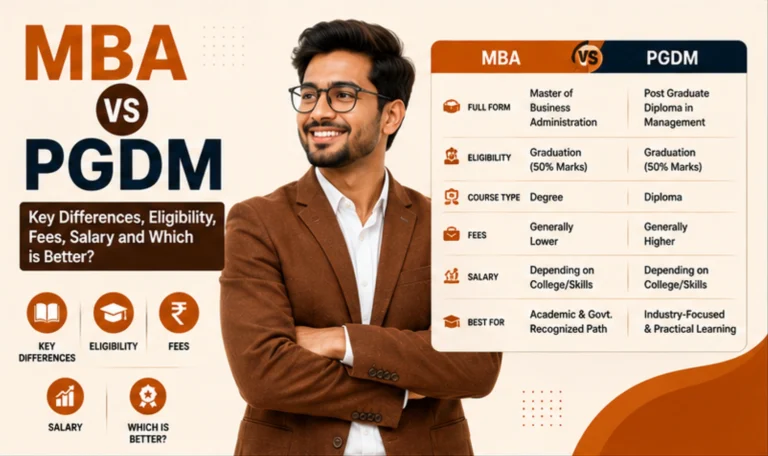
MBA vs PGDM at a glance: An MBA is a university-awarded postgraduate degree, while a PGDM is a…
Read More →
Priya is a 30-year-old marketing operations professional. She prepares campaign reports, tracks conversion numbers and works with dashboards…
Read More →
Move from coordinating tasks to leading projects that shape business outcomes Aman is a 29-year-old site engineer with…
Read More →
You have probably reached a familiar point. Perhaps you have three or four years of work experience and…
Read More →
A practical comparison framework for prospective students evaluating recognised online MBA programmes in India. The right online MBA…
Read More →
Rahul has been working as a software engineer for four years. He knows moving into a managerial role…
Read More →