



Top MBA Marketing Project Topics for Online MBA Final Year Students
Choosing a topic for your final-year MBA project is an important part of completing your management degree. A…
Read More →
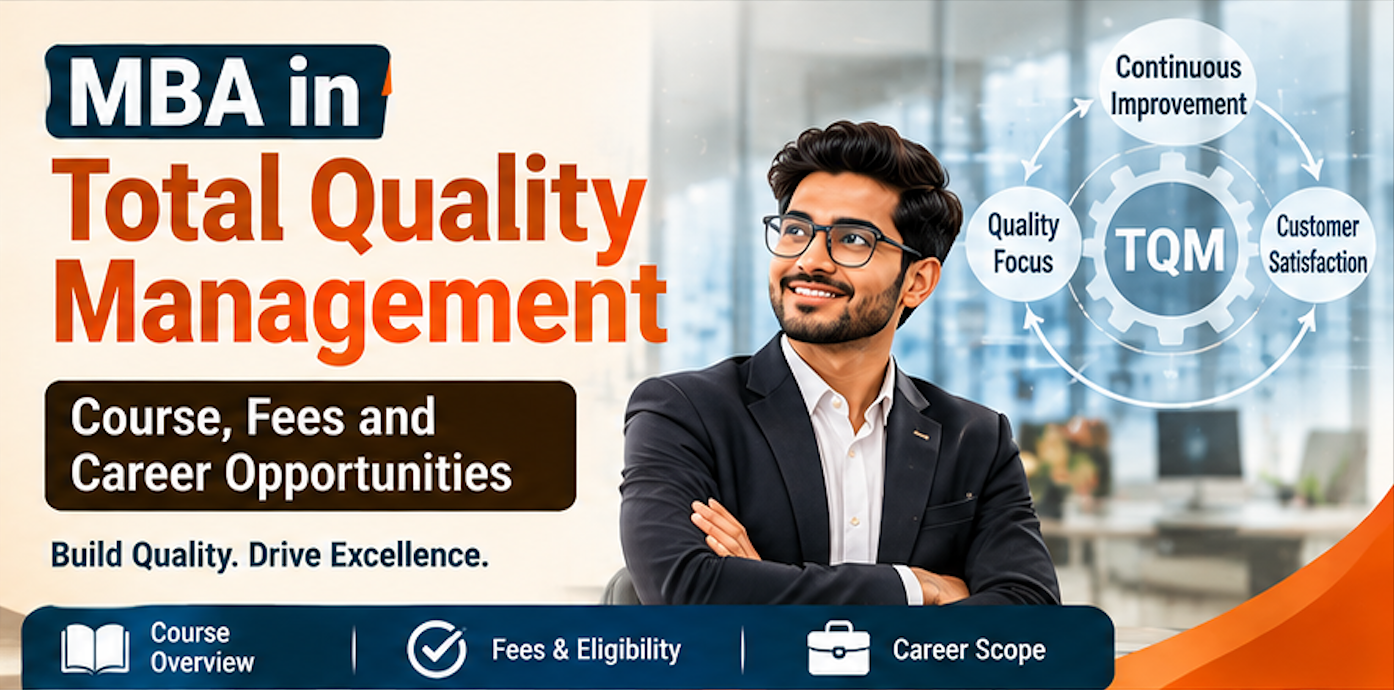
Interested in building a career in quality management or improving how businesses operate? An MBA in Total Quality Management (TQM) can help you develop the skills to improve processes, maintain quality standards and manage business operations. It can be a suitable choice for graduates and working professionals interested in quality assurance, operations and process improvement.
An MBA in Total Quality Management is typically a two-year postgraduate programme divided into four semesters. It combines core management subjects with specialised topics such as Six Sigma, Lean Management, Statistical Quality Control and Quality Audits. Delivery modes include full-time on-campus, online and distance formats. Eligibility typically needs a bachelor’s degree with 50% aggregate. An online MBA in Total Quality Management may be suitable for working professionals seeking greater flexibility.
Eligibility rules follow the standard MBA framework. The list below covers typical requirements across UGC and AICTE approved programmes.
Graduates in engineering, science and commerce may find this specialisation particularly relevant. Prior experience in manufacturing or operations can also be beneficial. Check the university’s specific requirements before applying.
MBA in TQM fees vary depending on the university and mode of study. The table below provides an indicative comparison of semester-wise and total programme fees.
| Programme Type | Per Semester (₹) | Total Fee (₹) | Payment Mode |
| Full-time MBA (Private University) | 1,00,000 to 2,50,000 | 4,00,000 to 10,00,000 | Semester-wise |
| Online MBA (UGC-DEB entitled) | 37,500 to 50,000 | 1,50,000 to 2,00,000 | Semester or EMI |
| Distance MBA (IGNOU) | 12,700 to 16,200 | 50,800 to 64,800 | Annual |
| Executive MBA (Weekend) | 1,25,000 to 2,00,000 | 5,00,000 to 8,00,000 | Semester-wise |
Additional expenses may include application fees, examination fees and study materials. Full-time students may also need to budget for accommodation and living costs.
Several UGC entitled providers offer flexible payment and merit-based support. The list below covers the main options.
Ask the admissions team for the full fee breakdown before committing. Payment plan flexibility is highest at UGC entitled online providers.
The MBA total quality management syllabus combines core business subjects with quality management concepts. The table below outlines a semester-wise course structure.
| Semester | Core Management Subjects | Quality-Specific Subjects |
| Sem 1 | Managerial Economics, Financial Accounting, Organisational Behaviour | Introduction to TQM, Quality Concepts |
| Sem 2 | Operations Management, Marketing Management, HRM, Business Statistics | Statistical Quality Control, Process Capability |
| Sem 3 | Strategic Management, Business Analytics, Financial Management | Six Sigma, Lean Management, ISO Standards |
| Sem 4 | Business Research, Capstone Project | Quality Audits, Supply Chain Quality, TQM Case Studies |
The admission process is standardised at most institutes. The steps below cover the typical sequence from application to enrollment.
UGC entitled online MBAs complete the process in 7 to 15 days. Keep documents scanned and ready in advance.
An MBA in Total Quality Management helps students develop business, analytical and quality management skills, including:
These skills apply across manufacturing, services, IT and healthcare sectors. A Six Sigma certification can further strengthen your professional qualifications. Practical projects can also help you apply quality management concepts to business situations.
Graduates enter quality, operations and process improvement roles across sectors. The table below covers common job roles and salary ranges.
| Job Role | Average Annual Salary (₹LPA) | Core Skills / Domain |
| Quality Manager | 6 to 14 | ISO, audits, process control |
| Operations Manager | 7 to 15 | Operations strategy, team leadership |
| Six Sigma Black Belt | 10 to 20 | DMAIC, project leadership |
| Process Improvement Lead | 8 to 16 | Lean, continuous improvement |
| Supply Chain Quality Manager | 8 to 16 | Supplier quality, logistics |
| Quality Assurance Analyst | 4 to 8 | Testing, process verification |
| Quality Consultant | 10 to 20 | Advisory, audit, strategy |
| Production Manager | 7 to 15 | Shop-floor management, output |
If you want to pursue a career in quality management or operations, an MBA can help you develop relevant business and analytical skills. JIIT Online offers a flexible, UGC-entitled MBA programme for students and working professionals looking to advance their education. Explore the programme and apply at admission.jiitonline.com.
Fees range from ₹50,800 at IGNOU to ₹10 lakh at private universities. UGC entitled online MBAs sit at ₹1.5 to 2 lakh.
Starting salaries range from ₹5 to 10 lakh for freshers. Working professionals with 2 to 5 years experience earn ₹8 to 15 lakh post MBA.
Quality Manager, Operations Manager, Six Sigma Black Belt, Process Improvement Lead, Supply Chain Quality Manager and Quality Consultant roles across sectors.
No. Operations Management covers broader operations strategy. TQM focuses specifically on quality systems, Six Sigma, Lean and continuous improvement.
No at most UGC-DEB entitled online providers. Admission is merit-based through the application portal. Premium institutes require CAT, XAT or equivalent scores.
Yes to both. Six Sigma Green and Black Belt certifications complement the degree. PhD in Management or Quality Engineering is a natural research path.
Six Sigma, Lean, ISO standards, statistical quality control, process improvement, project management and quality audits alongside core management and leadership skills.

Choosing a topic for your final-year MBA project is an important part of completing your management degree. A…
Read More →
India’s growing pharmaceutical industry offers career opportunities beyond research, manufacturing and medicine development. If you are interested in…
Read More →
Planning to pursue an MBA but unsure how long it will take? The MBA years of study depend…
Read More →
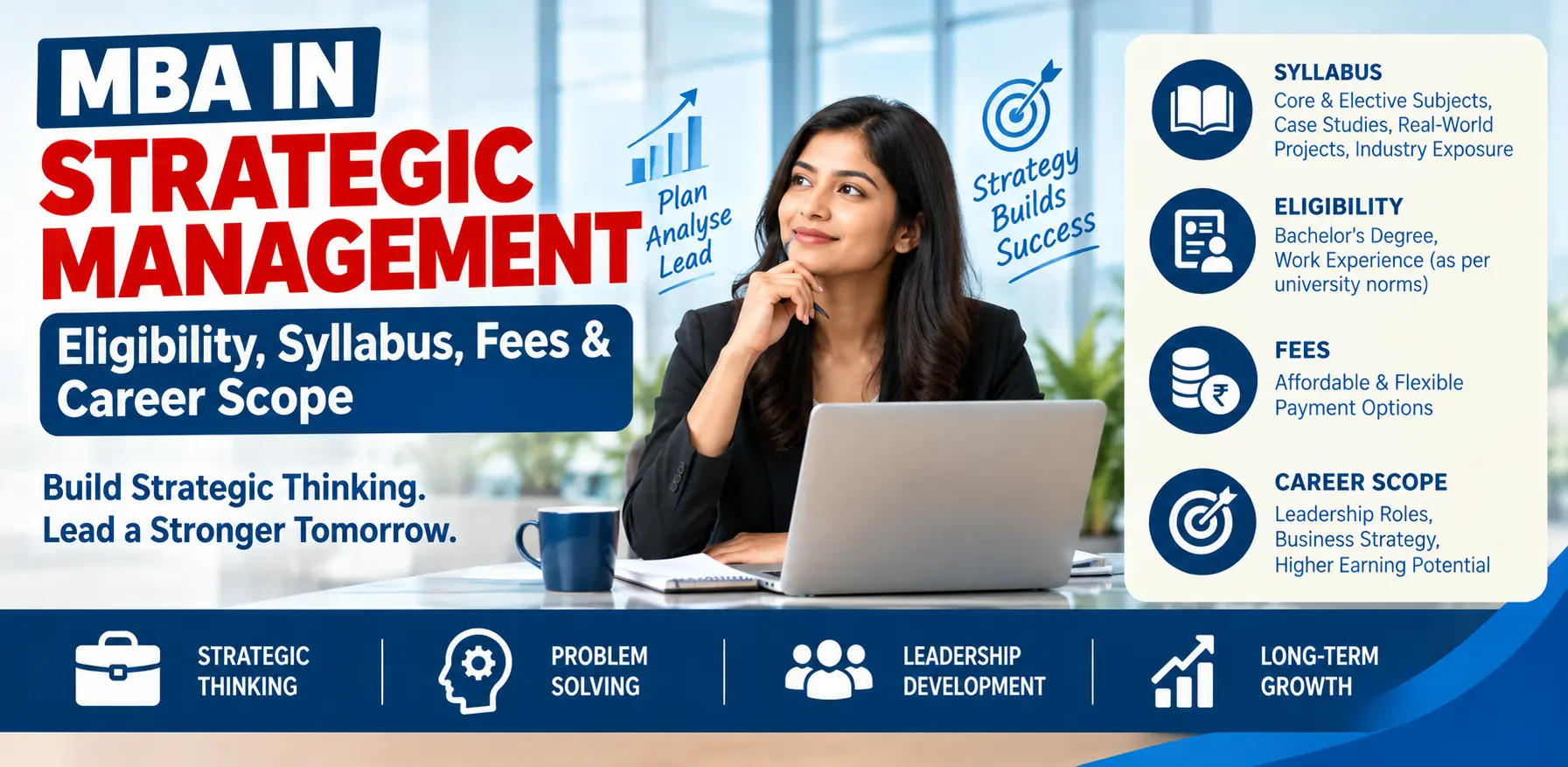
An MBA in Strategic Management is designed for students who want to understand how businesses make long-term decisions,…
Read More →
A part-time MBA can be a practical choice if you want to advance your career without stepping away…
Read More →
Retail today goes far beyond managing stores. It includes customer experience, merchandising, supply chains, e-commerce, branding, analytics, and…
Read More →
An MBA after B.Sc can be a strong next step if you want to combine your science background…
Read More →
Choosing an MBA after a BA can be a smart move if you want to shift from a…
Read More →
An MBA after B.Tech combines engineering fundamentals with management, finance and business strategy skills. It opens a new…
Read More →
Want to earn an MBA without stepping away from your job or other responsibilities? The benefits of an…
Read More →