




Top MBA Marketing Project Topics for Online MBA Final Year Students
Choosing a topic for your final-year MBA project is an important part of completing your management degree. A…
Read More →

Planning to pursue an MBA but unsure how long it will take? The MBA years of study depend on the programme you choose and your career goals. While a regular MBA usually takes two years, other formats offer different durations and learning schedules. Understanding the MBA course duration can help you choose a programme that fits your professional and personal commitments.
A standard full-time MBA in India takes two years across four semesters. Online and distance MBAs generally follow the same duration, although some UGC-DEB entitled providers allow additional time for completion. Executive MBA programmes vary in duration, while one-year management programmes are available at institutions such as ISB and select IIMs. Integrated management programmes typically take five years after Class 12.
A full-time MBA runs for 2 years across 4 semesters at AICTE-approved and UGC-recognised institutes. It involves on-campus residential learning, summer internship between years and placement at the end of year two. IIMs, FMS, SPJIMR and premium private institutes offer this format. It suits students and professionals who can commit to full-time study and regular campus attendance.
An online MBA at UGC-DEB entitled providers runs for 2 years across 4 semesters with digital delivery. Students can access learning materials through digital platforms, with live or recorded classes. Some institutions allow additional time to complete the programme. This format is particularly suitable for working professionals who want to continue their careers while studying.
A distance MBA at UGC-DEB entitled universities also runs for 2 years with flexibility up to 5 years. IGNOU, Symbiosis SCDL and select state universities offer this format. The format primarily involves self-study materials, online academic resources and scheduled examinations. It suits students who prefer independent learning.
Executive MBA programmes generally cater to experienced professionals looking to develop leadership and management skills. Programme durations vary, with many offering weekend, evening or modular learning schedules. Work experience requirements also differ by institution, making it important to review the admission criteria before applying.
A one-year MBA like ISB PGP, IIMA PGPX or IIMB EPGP covers 12 months full-time. Candidates typically need 5 or more years of work experience. The intensive format suits professionals seeking a career pivot without a 2-year pause. Fees are higher at ₹20 to 40 lakh.
The table below summarises MBA duration across formats.
| MBA Type | Duration | Semesters | Who It Is For | Work Experience Needed |
| Full-Time MBA | 2 years | 4 | Freshers and early-career candidates | 0 to 2 years |
| Online MBA | 2 years (extendable up to 4) | 4 | Working professionals and remote learners | 0 to 10 years |
| Distance MBA | 2 years (extendable up to 5) | 4 | Self-directed professionals | 0 to 10 years |
| Executive MBA | 15 to 24 months | 3 to 4 | Mid-career professionals | 5 plus years |
| One-Year MBA / PGPX | 12 months | 3 to 4 | Senior professionals seeking a pivot | 5 plus years |
A standard two-year MBA has four semesters covering core management subjects, specialisation electives and practical learning. The semester-wise structure generally includes:
Online MBAs generally follow a similar four-semester structure, while executive and one-year programmes may have different academic schedules depending on the institution.
The online MBA duration is generally two years across four semesters at UGC-DEB entitled providers. The maximum completion window typically extends up to 4 years based on university policy. UGC rules allow extended duration for working professionals who need flexibility. Students pay a nominal re-registration fee for each additional semester beyond the standard 4. Verify maximum duration with the specific university before enrolling, since the policy can change across academic cycles.
One-year MBAs are valid in India but with important distinctions. Programmes awarded as a PGPX or PGP by AICTE-approved autonomous institutes (ISB, IIMA, IIMB) carry industry recognition equivalent to a 2-year MBA. These are postgraduate diplomas, not technically MBA degrees. Full one-year MBA degrees require UGC approval, which most Indian universities do not currently hold for the 1-year format. Candidates targeting a true 1-year MBA degree typically pursue it abroad at INSEAD, IMD or Oxford. Verify the specific programme’s regulatory recognition before enrolling.
MBA duration also differs across countries and universities. The table below shows the typical time required to complete an MBA in different study destinations.
| Country | Typical Duration |
| India (full-time) | 2 years |
| USA | 2 years |
| UK | 1 year |
| Europe (INSEAD, IMD) | 10 to 12 months |
| Australia | 1.5 to 2 years |
| Canada | 1 to 2 years |
| Singapore (NUS, NTU) | 17 months |
The right MBA duration depends on your career goals, work experience and available time. Consider the following factors before choosing a programme:
Choose a programme that fits your professional goals and personal commitments. Online MBAs deliver strong ROI for working professionals who continue earning during the programme.
JIIT Online offers a UGC-DEB entitled, two-year online MBA across four semesters. Students can choose from specialisations in Financial Management, Marketing Management, Human Resource Management and IT & Business Analytics. The programme offers flexible online learning, making it suitable for working professionals who wish to continue their education without leaving their jobs. With a total fee of ₹1,75,000 and Zero-Cost EMI options, students can plan their education expenses more conveniently. Apply at admission.jiitonline.com.
Choosing the right MBA programme involves considering both the duration and how it fits your career plans. Whether you are a recent graduate or a working professional, understanding the available study formats can help you make an informed decision. If flexibility is important to you, JIIT Online’s two-year UGC entitled MBA offers an opportunity to develop management skills while continuing your professional commitments.
A full-time MBA in India takes 2 years across 4 semesters. Online and distance MBAs run for 2 years with flexibility to extend up to 4 to 5 years at UGC entitled providers.
An MBA has 4 semesters across 2 years. Each semester covers a mix of core management subjects, specialisation electives and applied projects or internships.
One-year MBAs in India are available as PGPX or PGP programmes at ISB, IIMA and IIMB. These are postgraduate diplomas rather than MBA degrees but carry equivalent industry recognition.
An online MBA at UGC-DEB entitled providers runs for 2 years across 4 semesters. Students can extend completion up to 4 years based on university policy for working professionals.
The maximum completion window is typically 4 years at UGC entitled online providers. Verify the specific policy with the university before enrolling since it varies by institute.
Yes at UGC-DEB entitled universities. Online MBAs carry equal legal validity as regular MBAs for jobs, government roles, PSUs and higher studies including PhD.
Most Executive MBAs require 5 or more years of work experience. ISB PGP, IIMA PGPX and reputed Executive MBAs follow this threshold during selection.
Integrated BBA plus MBA programmes span 5 years from Class 12. IIM Indore IPM, NMIMS and select private universities offer this format with a 3-year undergraduate plus 2-year postgraduate split.

Choosing a topic for your final-year MBA project is an important part of completing your management degree. A…
Read More →
India’s growing pharmaceutical industry offers career opportunities beyond research, manufacturing and medicine development. If you are interested in…
Read More →
Interested in building a career in quality management or improving how businesses operate? An MBA in Total Quality…
Read More →
An MBA in Strategic Management is designed for students who want to understand how businesses make long-term decisions,…
Read More →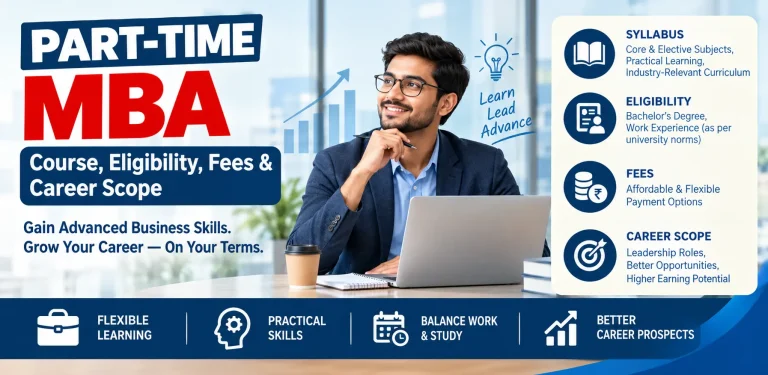
A part-time MBA can be a practical choice if you want to advance your career without stepping away…
Read More →
Retail today goes far beyond managing stores. It includes customer experience, merchandising, supply chains, e-commerce, branding, analytics, and…
Read More →
An MBA after B.Sc can be a strong next step if you want to combine your science background…
Read More →
Choosing an MBA after a BA can be a smart move if you want to shift from a…
Read More →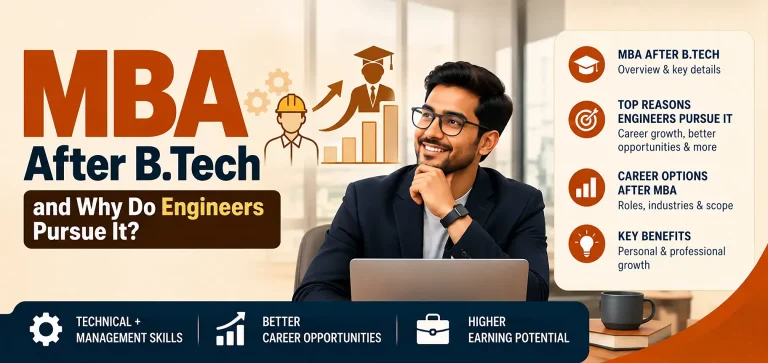
An MBA after B.Tech combines engineering fundamentals with management, finance and business strategy skills. It opens a new…
Read More →
Want to earn an MBA without stepping away from your job or other responsibilities? The benefits of an…
Read More →