







BBA in General Management: Eligibility, Subjects & Career Scope
A BBA in general management is a three-year undergraduate business degree covering management fundamentals, marketing, finance, HR, operations,…
Read More →
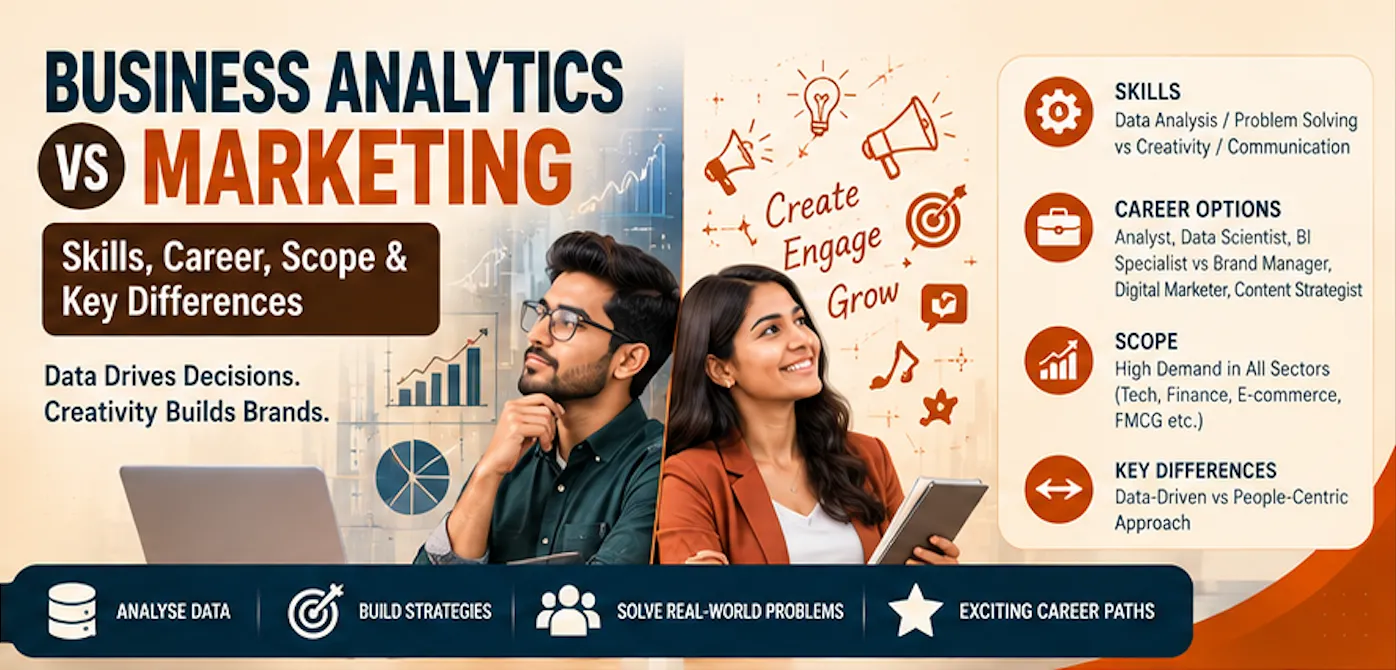
Trying to choose between business analytics and marketing? The two can lead to very different day-to-day work, even though they often support the same business goals. One leans more on data and patterns, while the other focuses more on customers, communication and campaigns. Understanding business analytics vs marketing can help you see which path feels more natural for your skills and interests.
Business analytics in marketing uses data to guide decisions around customers, campaigns, pricing and channels. Analysts study behaviour patterns, campaign performance, sales trends and marketing ROI to sharpen strategy. The output helps marketing teams choose which audience to target, which channel to spend on and which creative works. Modern marketing runs on this analytical layer.
The two disciplines differ across primary focus, tools, decision approach and career fit. The table below lays out the comparison.
| Factor | Business Analytics | Marketing |
| Primary Focus | Data-driven insights and forecasting | Brand, demand and customer engagement |
| Role of Data | Central input | Supporting input |
| Decision-Making Approach | Quantitative and evidence-based | Creative and consumer-led |
| Core Skills | Statistics, SQL, visualisation | Copy, positioning, campaign design |
| Tools Used | Excel, SQL, Power BI, Tableau, Python | Google Analytics, SEO tools, CRM, ad platforms |
| Customer Interaction | Indirect through data | Direct through campaigns and content |
| Business Functions | Cross-functional analytics support | Brand, growth, sales enablement |
| Career Opportunities | Analyst, BI, consulting | Manager, specialist, brand roles |
| Suitable Candidates | Analytical, quantitative thinkers | Creative, communication-led thinkers |
Analytics is now embedded across every step of the modern marketing workflow. The applications below show where the two disciplines intersect.
Marketing teams without analytics run blind on spend and outcomes. The stronger a brand’s analytics stack, the sharper its marketing decisions become. This intersection creates hybrid roles such as marketing analyst and growth analyst.
The two career tracks share communication and problem-solving as common ground but diverge on technical depth. Skills below map to their primary discipline.
Analytics roles reward technical depth in tools and statistics. Marketing roles reward creativity, empathy and channel mastery. Hybrid roles benefit from strength on both sides.
| Discipline | Career Roles |
| Business Analytics | Business Analyst, Data Analyst, BI Analyst, Marketing Analyst, Analytics Consultant |
| Marketing | Marketing Manager, Digital Marketing Specialist, SEO Specialist, Brand Manager, Performance Marketing Specialist, Marketing Consultant |
Salary depends on experience, industry, role, location, company size, technical skills and qualifications. Entry-level business analyst roles typically pay ₹4 to 8 lakh in India. Marketing executive roles start at ₹3 to 6 lakh. Senior analytics and marketing roles cross ₹20 lakh at mid-career with strong performance.
The intersection of analytics and marketing is one of the fastest growing hiring pockets. Applications span every consumer-facing sector.
Firms increasingly hire marketing analysts and growth analysts as hybrid roles. Salaries for these positions typically outpace pure marketing or pure analytics tracks. Learning both disciplines opens the widest career goals.
Neither career is universally better. The right choice depends on the individual’s strengths and interests.
Test your fit by trying an internship in each. Many careers combine both over time, especially in growth and product-marketing roles.
Together, these uses make marketing decisions more focused, measurable, and easier to improve over time.
Business analytics and marketing work best when data and creativity come together. If you enjoy numbers, customer behaviour, campaigns, or a mix of all three, there are plenty of paths to explore. Choose the direction that fits your strengths and the kind of work you enjoy. Apply to JIIT Online at admission.jiitonline.com for its UGC entitled MBA with Business Analytics and Marketing electives.
Yes. Marketing decisions increasingly rely on customer, campaign and channel data. Analytics skills give marketers a measurable edge in career growth.
Neither is universally better. Analytics suits quantitative thinkers; marketing suits creative communicators. Hybrid growth and product-marketing roles benefit from strength in both.
Business analyst, data analyst, BI analyst, marketing analyst and analytics consultant on the data side. Marketing manager, brand manager, SEO specialist and performance marketer on the marketing side.
Yes. MBA Business Analytics welcomes graduates from marketing, commerce, engineering and arts backgrounds. Prior marketing experience helps in hybrid roles post MBA.
It replaces intuition with evidence across targeting, spend allocation, creative testing and ROI measurement. Firms with strong analytics run more efficient marketing.
Yes. Adding analytics skills opens senior marketing, growth and product-marketing roles. Hybrid profiles typically command higher salaries than single-discipline peers.

A BBA in general management is a three-year undergraduate business degree covering management fundamentals, marketing, finance, HR, operations,…
Read More →
Ever thought about what happens after you place an online order and before it reaches your doorstep? A…
Read More →
Ever wondered how a business can sell, grow, and compete in different countries? A BBA in Global Business…
Read More →
Just finished Class 12 and interested in how businesses work across countries? A BBA in Foreign Trade can…
Read More →
Want to pursue a BBA from India while continuing to live abroad? An online BBA for NRI students…
Read More →
Technology now plays a big role in how businesses work, and a BBA IT course helps you understand…
Read More →
Not sure which area of business interests you most yet? A BBA gives you the chance to explore…
Read More →
A BBA in Hotel Management suits students who want to understand the business side of hospitality, including hotel…
Read More →
A BBA in Entrepreneurship can suit students who want to understand how ideas become viable businesses, whether they…
Read More →
A BBA can lead directly to entry-level business roles, postgraduate study, professional certifications or entrepreneurship. The right route…
Read More →