

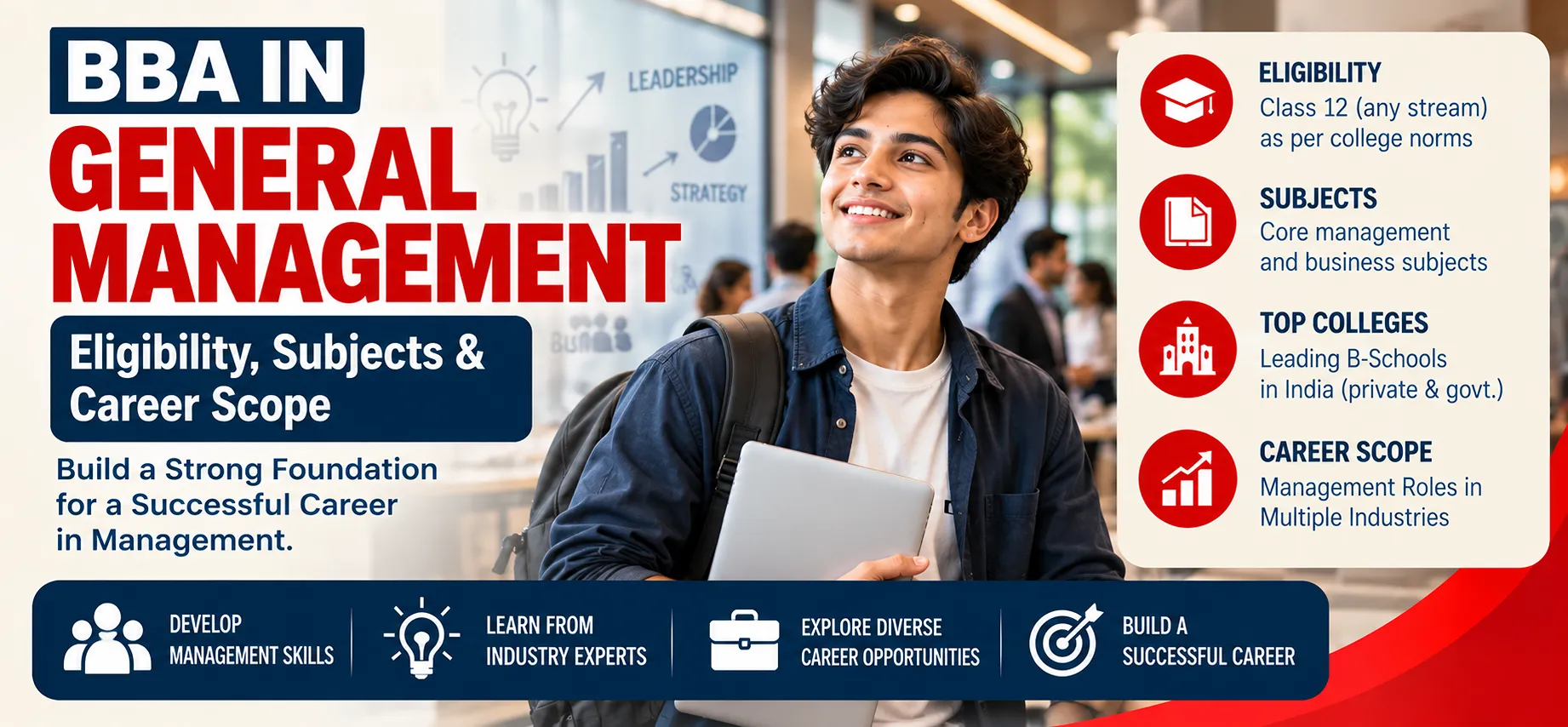




BBA in General Management: Eligibility, Subjects & Career Scope
A BBA in general management is a three-year undergraduate business degree covering management fundamentals, marketing, finance, HR, operations,…
Read More →

Not sure which area of business interests you most yet? A BBA gives you the chance to explore management, marketing, finance, entrepreneurship, and more before choosing your direction. Along the way, you can build practical skills, understand how businesses work and get a clearer idea of the roles you may want to pursue. Explore the advantages of a BBA course before deciding whether it matches your interests and future plans.
A BBA course offers concrete advantages across knowledge, skill development, and career preparation. Here are some of the benefits of a BBA that students can gain from the course.
BBA covers finance, marketing, HR, operations, economics, and management across six semesters. Students learn to read financial statements, plan marketing campaigns and design business processes.
Case studies, presentations, group projects and simulations develop leadership and decision-making skills. You may lead a project, present an idea or work with your team to solve a business problem. These experiences carry directly into internships and early-career roles.
Most BBA programmes include internships, live projects and industry interactions. Students apply classroom concepts to actual business problems at partner firms. This can help you connect what you learn in class with real business situations and feel better prepared for internships or employment.
At JIIT Online, you can pursue the course without visiting campus, so you can build business knowledge while managing other commitments.
BBA graduates enter marketing, sales, HR, finance, operations, and business development roles. Your first few roles can help you understand which business function suits your interests and strengths.
BBA gives aspiring entrepreneurs a foundation in business planning, finance, marketing, and operations. Students often start ventures during or immediately after the program. This can also be useful if you plan to join or manage a family business.
BBA is the common pathway to an MBA or PGDM. The undergraduate foundation makes MBA coursework more manageable. Specialised master’s programmes in analytics, finance or HR also accept BBA graduates.
There are multiple benefits of studying BBA after 12th that apply across business functions and industries. Assignments, presentations, projects, and internships can also help you develop skills useful in college and at work.
These BBA course benefits translate directly into internship and workplace effectiveness. Employers value candidates who can communicate, analyse and collaborate from day one. The course can also help you understand your strengths, interests and preferred career direction.
If you are interested in business, you may also be considering BCom or BA Economics. The table below compares the three across decision factors.
| Factor | BBA | BCom | BA Economics |
| Course Focus | Management and business practice | Commerce, accounting, taxation | Economic theory and analysis |
| Management Exposure | High, across all functions | Moderate | Low, unless with electives |
| Practical Learning | Case studies, projects, internships | Theoretical, limited projects | Theoretical, research-oriented |
| Career Areas | Marketing, HR, operations, sales | Accounting, tax, banking, audit | Research, analytics, consulting |
| Higher-Study Options | MBA, specialised masters | MCom, CA, MBA | MSc Economics, MBA, PhD |
| Suitable Students | Management-oriented, generalist | Accounting-oriented, detail-focused | Analytical, research-oriented |
Choose BBA when you want practical management exposure and diverse career paths. Choose BCom for accounting and taxation careers or BA Economics for research and analytics. The right option depends on the subjects you enjoy and the kind of career you want to explore.
Choosing the right BBA programme means looking at more than just the course name. Here are some factors worth checking before you decide.
Your priorities may be different from those of another student. Compare these factors with your own career goals, learning preferences and budget before finalising a programme.
The advantages of a BBA course include business knowledge, skill development, career flexibility, entrepreneurship exposure and higher-study preparation. It also gives you an opportunity to explore different areas of business before deciding where you want to specialise. Apply to JIIT Online for its UGC entitled online BBA at admission.jiitonline.com.
Business knowledge, leadership and decision-making skills, practical learning, career flexibility, an entrepreneurship foundation, and preparation for an MBA and higher studies.
Yes. It builds foundational business skills, opens diverse career paths and prepares students for an MBA. It suits students who want early, practical management exposure.
Yes. BBA is the standard undergraduate pathway to an MBA. Most MBA programmes accept BBA graduates with a 50% aggregate and a valid entrance exam score.
BBA is more management-focused with case studies and internships. BCom is more accounting- and commerce-focused with theoretical depth. Choose based on your career vector.
Yes. BBA covers business planning, finance, marketing and operations, giving aspiring entrepreneurs and family business successors a structured foundation.
Choose based on your career vector. Analytics for data careers, finance for BFSI, marketing for consumer roles, HR for people functions, or general management for flexibility.
Yes. BBA graduates enter management, marketing, HR, operations, finance, banking and business development roles across BFSI, IT, consulting and consumer sectors.
A BBA in general management is a three-year undergraduate business degree covering management fundamentals, marketing, finance, HR, operations,…
Read More →
Trying to choose between business analytics and marketing? The two can lead to very different day-to-day work, even…
Read More →
Ever thought about what happens after you place an online order and before it reaches your doorstep? A…
Read More →
Ever wondered how a business can sell, grow, and compete in different countries? A BBA in Global Business…
Read More →
Just finished Class 12 and interested in how businesses work across countries? A BBA in Foreign Trade can…
Read More →
Want to pursue a BBA from India while continuing to live abroad? An online BBA for NRI students…
Read More →
Technology now plays a big role in how businesses work, and a BBA IT course helps you understand…
Read More →
A BBA in Hotel Management suits students who want to understand the business side of hospitality, including hotel…
Read More →
A BBA in Entrepreneurship can suit students who want to understand how ideas become viable businesses, whether they…
Read More →
A BBA can lead directly to entry-level business roles, postgraduate study, professional certifications or entrepreneurship. The right route…
Read More →