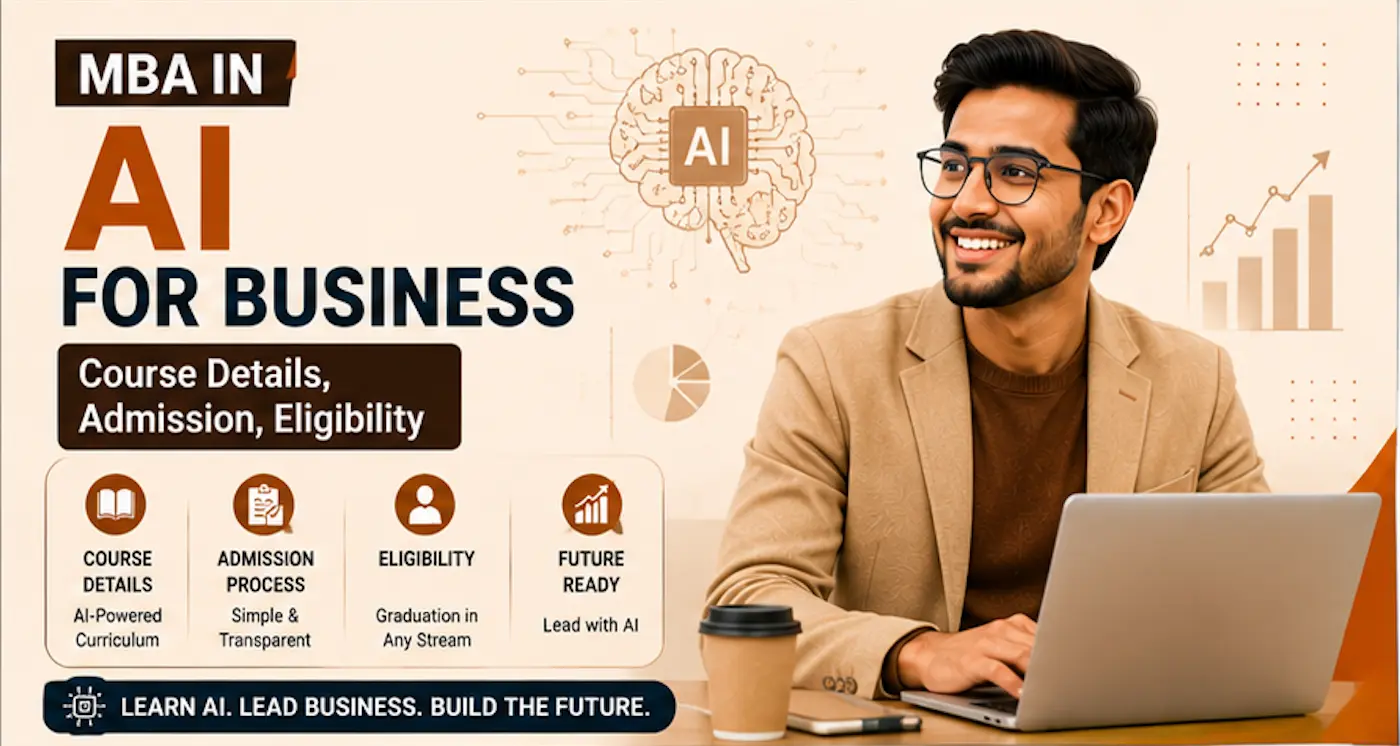
Artificial intelligence is changing how organisations forecast demand, personalise customer journeys, manage risk and automate decisions. An MBA in artificial intelligence is intended for learners who want to understand these business applications without moving into a purely technical AI degree. This guide compares MBA and PGDM routes for building that management-focused AI capability.
An MBA is a postgraduate management degree awarded by a recognised university, while a PGDM is a postgraduate diploma offered by an autonomous institute under the applicable regulatory framework. For someone exploring an MBA in artificial intelligence management, the more useful question is not degree versus diploma alone. It is whether the programme teaches business strategy, analytics, AI-enabled decision-making, governance and implementation strongly enough for the role you want.
Rhea, for example, works in operations and wants to move into AI-enabled process improvement. She does not need to become a machine-learning engineer. She needs a management programme that helps her evaluate AI use cases, understand data, work with technical teams and make commercially sound decisions.
When AI is part of your career plan, compare the programme at curriculum level rather than assuming that one qualification format is automatically more current or more employable. The table highlights the decision points that matter most.
| Parameter | MBA | PGDM |
|---|---|---|
| Qualification | Postgraduate degree from a university | Postgraduate diploma from an autonomous institute |
| Curriculum control | University-led; update speed varies by institution | Institute-led; update speed varies by institute |
| AI-business fit | Depends on subjects such as AI in business, analytics, digital transformation and governance | Depends on the institute’s electives, labs, cases and industry projects |
| Admission | May be merit-based or entrance-based, depending on the university | Often entrance-based, with institute-specific selection processes |
| Fees | Varies widely by institution and study mode | Varies widely by institute and programme positioning |
| Recognition | Degree recognition is usually straightforward for further study, subject to the receiving institution’s rules | For academic equivalence or further study, check the specific PGDM’s recognised equivalence status |
| Best decision test | Choose when the university, curriculum and delivery model fit your career goal | Choose when the institute, curriculum and outcomes justify the diploma route |
For AI-oriented management roles, look beyond labels such as “AI MBA”. Check whether the curriculum covers data interpretation, AI use-case evaluation, digital transformation, ethics, governance and business implementation. A programme can be useful without being named MBA in artificial intelligence if those capabilities are embedded meaningfully in the curriculum.
Neither format is universally better. The stronger choice is the programme that gives you the right combination of recognised qualification, relevant curriculum, practical learning and manageable cost.
For Rhea, the better route would be the one that lets her keep working while building enough analytics and AI-management fluency to move into technology-enabled operations. That is a more useful test than asking whether Online MBA or PGDM is superior in the abstract.
JIIT Online currently offers a two-year Online MBA with Financial Management, Marketing Management, Human Resource Management and IT & Business Analytics as major specialisations. Its curriculum also includes Artificial Intelligence in Business in Semester III. It does not currently list a separately named MBA in artificial intelligence management specialisation, so learners seeking this direction should assess whether the IT & Business Analytics pathway and AI-related coursework match their goals.
The right route into AI-focused management depends on programme substance, not just the qualification label. Whether you are comparing a PGDM with an MBA or exploring an MBA in artificial intelligence or MBA in artificial intelligence management, examine curriculum, recognition, flexibility and role fit before deciding.
Not automatically in every context. For employment or further study, check the PGDM’s current recognition and equivalence status with the relevant institution or authority.
Neither format guarantees stronger placements. Compare programme-level placement reports, role mix, employer participation, internships and career support rather than relying on MBA-versus-PGDM labels.
Fees reflect institute positioning, faculty, campus resources, programme design and services. Some PGDMs cost more, but neither qualification type is inherently more expensive.
Recruiters usually evaluate the institute, role-relevant skills, experience and interview performance. Recognition still matters, but the qualification label alone rarely determines hiring.
Both can support leadership development. Choose the programme that strengthens strategy, finance, people management, analytics and AI-enabled decision-making for your intended sector and role.