





MBA in AI for Business Course Details, Admission, Eligibility
Artificial intelligence is changing how organisations forecast demand, personalise customer journeys, manage risk and automate decisions. An MBA…
Read More →

A practical comparison framework for prospective students evaluating recognised online MBA programmes in India.
The right online MBA college is not simply the one with the most familiar name. It is the institution whose recognition, curriculum, delivery model, fees and student support fit your career goal. This guide explains how to compare online MBA options in 2026, where entrance exams may apply and what to verify before submitting an application.
Prospective students often begin with rankings or fees. Those details matter, but they should not be used in isolation. A more reliable shortlist considers the following factors together:
Rankings, fees and admission policies can change. Always verify current information on the university website and relevant regulator portals before applying.
The original draft listed the following institutions and indicative fee levels. Treat these figures as shortlist inputs, not confirmed 2026 quotations. Programme names, fees, recognition and admission rules must be checked directly with each institution.
| Institution or programme | Indicative fee in source draft | Admission route stated in source | What to verify |
|---|---|---|---|
| JIIT Online, Noida | Rs. 1,75,000 | Merit-based in the source draft | Verify programme entitlement, current fee and eligibility |
| NMIMS Global | Rs. 1,80,000+ | NMAT or merit in the source draft | Confirm whether the selected programme requires a test |
| Amity Online | Rs. 1,99,000 | Merit-based in the source draft | Check current programme fee and admission criteria |
| Manipal Online (MAHE) | Rs. 1,66,000 | Merit-based in the source draft | Confirm the exact university and programme details |
| DY Patil Online | Rs. 1,50,000 | Merit-based in the source draft | Verify current entitlement and total payable fee |
| IIM Kozhikode executive online offering | Rs. 6,50,000+ | CAT or GMAT in the source draft | Confirm programme type, work experience and selection process |
MBA eligibility varies depending on the institution and programme type. Standard online MBA programmes may accept graduates from any discipline, while executive or premium programmes may require minimum marks, work experience, an entrance score or an interview. Do not assume that one university’s criteria apply to another.
| Programme type | Typical academic requirement | Work experience | Possible selection requirement |
|---|---|---|---|
| Standard online MBA | Bachelor’s degree, often in any discipline | Minimum marks may apply | Usually not mandatory, but verify |
| Career-focused or executive programme | Bachelor’s degree | Experience may be preferred or required | May include interview or screening |
| Selective premium programme | Bachelor’s degree plus substantial work experience | Programme-specific threshold | CAT, GMAT or another test may apply |
Not for every online MBA. Many private and deemed universities use a merit-based admission process, which may rely primarily on graduation marks and document verification. Selective executive or premium programmes can require an entrance score, work experience, an interview or a combination of these.
The practical question is therefore not “Which exam is accepted by online MBA colleges?” but “Does the exact programme I am applying to require an exam?” Check the latest admission page rather than preparing for a test based on a general comparison article.
| Exam | Where it may be relevant | Student takeaway |
|---|---|---|
| CAT | Commonly associated with IIM and other selective management admissions | Use only if the target programme explicitly asks for it |
| MAT | Accepted by participating management institutions | Acceptance varies by institution and programme |
| XAT | Used by XLRI and participating institutions | Not a universal online MBA requirement |
| CMAT | Accepted by participating AICTE-approved institutions | Verify the programme’s current admission notice |
| ATMA | Accepted by participating management schools | Check the applicable admission cycle |
This route generally suits applicants who want to begin an online MBA without preparing for a national-level management entrance exam. Admission may depend on graduation marks, eligibility checks and document verification. Some institutions may also ask for a statement, interview or internal assessment.
This route is more common in selective executive and premium programmes. Applicants may need a valid test score, relevant work experience and an interview. A higher fee or more selective process does not automatically make a programme suitable for every student. The value depends on the programme’s target audience and your career objective.
The exact process varies, but most applicants move through the following stages. Complete each step only on the official university portal or through a clearly authorised admission channel.
| Step | Action | What to keep ready |
|---|---|---|
| 1 | Check programme recognition, eligibility, curriculum and total fee | Official programme and regulator information |
| 2 | Register and complete the application form | Email, mobile number and identity details |
| 3 | Upload academic and identity documents | Class 10, Class 12, graduation and ID records as requested |
| 4 | Complete any required test, statement or interview | Programme-specific requirement |
| 5 | Pay the application or admission fee through the authorised portal | Approved digital payment method |
| 6 | Wait for verification and admission confirmation | Offer letter or confirmation sent by the institution |
| 7 | Activate the learning platform and review the academic calendar | Login details, orientation information and schedule |
A specialisation should support the role you want next, not merely reflect your current job title. Compare the actual subjects, electives and assessment pattern before deciding.
| Specialisation | What to examine in the curriculum | Who may find it relevant |
|---|---|---|
| Finance | Corporate finance, financial analysis, investment concepts and risk | BFSI professionals, analysts and learners moving into finance roles |
| Marketing | Consumer behaviour, brand management, digital marketing and sales strategy | Marketing, sales, growth and brand professionals |
| Human resources | Talent management, labour relations, learning and organisational behaviour | HR generalists and people-management professionals |
| Business analytics | Statistics, data interpretation, visualisation and decision models | Professionals who want data-informed management roles |
Location is less important in an online programme than recognition, curriculum and delivery quality. However, Delhi NCR students may still value regional alumni access, nearby institutional events or easier interaction with a locally based university. JIIT Online therefore be worth evaluating, provided their current programme details match the student’s objective.
For a finance-focused shortlist, review the precise finance electives, faculty background, assessment method, industry exposure and placement support. The source draft mentions subjects such as Security Analysis, Portfolio Management, Financial Statement Analysis and Behavioural Finance in relation to JIIT. These details should be confirmed against the current official curriculum before they are used to make an admission decision.
The better format depends on the student’s circumstances. An online MBA can suit working professionals who need schedule flexibility, while a regular MBA can provide a more immersive campus experience and stronger day-to-day peer interaction.
| Parameter | Online MBA | Regular MBA |
|---|---|---|
| Study format | Remote learning with scheduled or flexible online components | Campus-based, usually full-time |
| Flexibility | Generally higher | Generally lower |
| Networking | Digital cohorts, alumni and virtual interaction | Frequent in-person interaction |
| Career use case | Upskilling, promotion or role progression while working | Often used for a larger career reset or campus placement route |
| Cost | Often lower, but varies considerably | Often higher, but varies by institution |
| Admission | May be merit-based or programme-specific | Entrance tests are common for selective institutions |
An online MBA does not guarantee a salary increase or a particular employer. Outcomes depend on prior experience, job function, industry, location, the quality of the programme and how effectively the learner applies new skills. For this reason, the salary ranges and recruiter lists in the original draft should not be treated as verified outcomes unless they are supported by current, programme-specific placement reports.
A more useful ROI calculation compares the total fee and study time with the realistic career benefit you are pursuing, such as eligibility for a promotion, movement into a management role, stronger business knowledge or a transition into a related function.
The best online MBA in India is not a universal list position. It is the programme that is properly recognised, financially manageable and aligned with the role you want to pursue. Start by verifying recognition and eligibility, then compare curriculum, learning format, total fee and career support. JIIT Online may be considered alongside other options when its current programme structure and student support match these requirements.
There is no single best choice for every student. Compare recognised programmes on curriculum, total fee, admission requirements, learning support and relevance to your career goal. Rankings can support the comparison, but they should not replace programme-level verification.
No. Many online MBA programmes use merit-based admission, while selective executive or premium programmes may require CAT, GMAT, another test, work experience or an interview. Check the exact programme’s current admission criteria.
A recognised bachelor’s degree is the usual academic requirement. Minimum marks, work experience and other conditions vary by institution and programme, so applicants should verify the current eligibility notice before applying.
Students may evaluate JIIT Online and other institutions with a Delhi NCR presence, but location should not be the only deciding factor. Compare recognition, finance electives, delivery quality, fee and career support.
An online MBA offers greater flexibility and is often designed for learners who want to continue working. A regular MBA provides a more immersive campus experience and may offer stronger in-person networking and campus-placement access.

Artificial intelligence is changing how organisations forecast demand, personalise customer journeys, manage risk and automate decisions. An MBA…
Read More →
An MBA in Business Management is useful for learners who want broad management capability before committing deeply to…
Read More →
For professionals and graduates interested in cross-border markets, trade, global strategy or multinational operations, an MBA in International…
Read More →
An MBA in Sports Management can suit learners who want to work on the business side of sport…
Read More →
An MBA in Entrepreneurship helps learners understand how ideas become viable businesses, how ventures are financed and how…
Read More →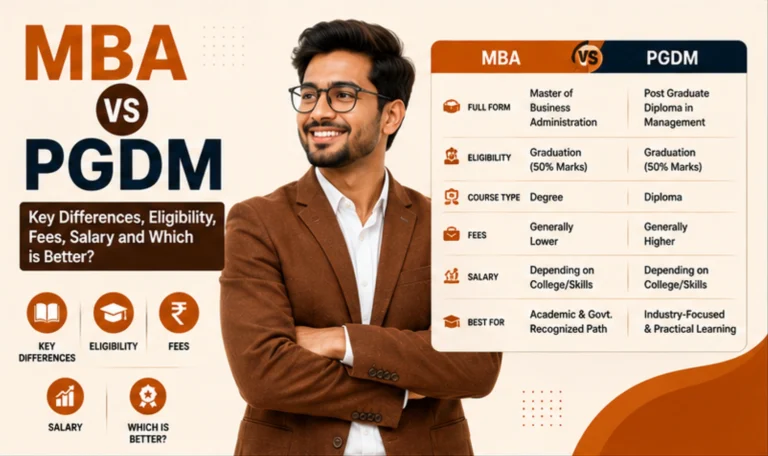
MBA vs PGDM at a glance: An MBA is a university-awarded postgraduate degree, while a PGDM is a…
Read More →
Priya is a 30-year-old marketing operations professional. She prepares campaign reports, tracks conversion numbers and works with dashboards…
Read More →
Move from coordinating tasks to leading projects that shape business outcomes Aman is a 29-year-old site engineer with…
Read More →
You have probably reached a familiar point. Perhaps you have three or four years of work experience and…
Read More →
Rahul has been working as a software engineer for four years. He knows moving into a managerial role…
Read More →