





MCA Courses in India 2026: Types, Top Universities, Fees & Career Scope
The Master of Computer Applications (MCA) remains one of the most sought-after postgraduate programmes in India for students…
Read More →

Cloud Computing is a better fit if you want to build, deploy, and scale digital infrastructure; Cyber Security is better suited to protecting systems, investigating risks, and strengthening controls. For Meera, an application-support professional considering an MCA, the decision should come from the work she wants to do after graduation, not from generic salary claims. Review the current JIIT Online MCA curriculum before applying.
An MCA in Cloud Computing focuses on cloud infrastructure, distributed systems, virtualisation, networking and deployment. Learning may include AWS, Microsoft Azure, Google Cloud, containers and DevOps practices. If you are also considering an online MCA course in DevOps, check whether the curriculum covers Linux, networking, automation and CI/CD rather than relying on the programme label. Typical pathways include cloud support, cloud engineering, DevOps and platform roles across technology, BFSI, e-commerce and other cloud-using sectors.
An MCA in Cyber Security focuses on protecting applications, networks, systems and data. Typical topics include information security, network security, ethical hacking, vulnerability assessment, cryptography, digital forensics and incident response. The field suits learners who enjoy investigation and structured problem-solving. Careers may exist across IT services, consulting, financial services, healthcare and other organisations that manage sensitive systems or data. Practical labs and security exercises matter as much as theory when comparing programmes.
Use the comparison as a decision aid, then verify the university’s exact subjects and practical components.
| Parameter | Cloud Computing | Cyber Security |
| Focus | Deploying and scaling systems | Protecting systems and data |
| Core skills | Cloud architecture, networking, automation | Networks, vulnerability analysis, incident response |
| Technologies | Cloud platforms, containers, CI/CD | Security monitoring, testing and analysis tools |
| Career paths | Cloud, DevOps, platform roles | Security analyst, SOC, testing, consulting |
| Salary | Role- and experience-dependent | Role- and experience-dependent |
| Best suited for | Builders and systems thinkers | Investigative, detail-focused problem-solvers |
Job titles depend on practical skills, projects, prior experience and current vacancies. These roles show how the two pathways differ.
| Job role | Pathway | Typical work |
| Cloud Engineer | Cloud | Configure services, support deployments, monitor infrastructure |
| Cloud Architect | Cloud | Design cloud environments and architecture trade-offs |
| DevOps Engineer | Cloud | Automate build, test and deployment workflows |
| Security Analyst | Cyber | Monitor alerts, investigate events, support controls |
| Ethical Hacker | Cyber | Test authorised systems and report weaknesses |
| SOC Analyst | Cyber | Triage alerts and escalate incidents |
| Information Security Consultant | Cyber | Assess security needs, controls and risks |
There is no dependable salary band for either specialisation. Compensation changes with role, city, employer, experience and demonstrated capability. Senior architecture or consulting roles may pay more than entry-level positions, but those roles usually require substantial experience. Use current role-specific market data only after choosing a target job.
| Career level | Cloud salary context | Cyber salary context | Top recruiters/employer types |
| Entry | Support or junior cloud roles | SOC or junior security roles | IT services, managed services, technology teams |
| Mid | Cloud engineering, DevOps, platform work | Security engineering, incident or governance work | Consultancies, BFSI, cloud-using enterprises |
| Senior | Architecture or platform leadership | Security architecture or specialist consulting | Large enterprises, product firms, specialist consultancies |
Choose Cloud Computing if you are drawn to infrastructure, deployment, automation and reliability. Choose Cyber Security if you prefer defence, investigation, testing or technology risk. For Meera, a useful test is whether she would rather build and automate an application environment or analyse why a system is vulnerable and how to protect it. That question is more useful than comparing generic pay claims.
As of 17 August 2026, JIIT Online lists a two-year MCA with Information Security, a Cloud Computing & Deployment elective, virtual labs, projects and a major project. Its current page also identifies cloud computing and cyber security as learning areas. This lets Meera compare both directions within the published curriculum without assuming JIIT awards two separately named specialisation degrees. Verify the latest electives, fees and admissions before enrolling.

Neither is universally better. Cloud suits infrastructure and automation goals; Cyber Security suits defence, investigation and risk. Choose from the work you want to perform.
Neither guarantees higher pay. Salary depends on role, employer, location, experience and skills. Compare current role-level data rather than a degree-wide average.
Both appear across sectors, but vacancy volumes change. Cloud spans infrastructure, DevOps and platform teams; cyber spans security operations, testing, risk and incident response.
Not automatically. Freshers can enter either pathway with strong fundamentals, labs and projects. Choose the area you are more willing to practise consistently.
Difficulty depends on your background. Cloud may suit learners comfortable with Linux and networking; cyber may suit those who enjoy systems, investigation and security concepts.
Consider role-based AWS, Microsoft Azure or Google Cloud certifications that match your target platform. Verify the current exam name and prerequisites before registering.
Start with current foundational security or networking certifications. Advanced credentials may require work experience, so check the issuing body’s latest eligibility rules first.
Yes. Networking, operating systems, cloud and scripting knowledge can transfer, but you will need security-specific practice in monitoring, vulnerabilities, access control and incident response.
Infrastructure, software or operations experience may connect naturally with cloud, while audit, governance, networking or existing security exposure may support a cyber transition.
Neither is guaranteed to be future-proof. Long-term relevance depends on strong fundamentals, practical experience and continuous learning as technologies and threats evolve.

The Master of Computer Applications (MCA) remains one of the most sought-after postgraduate programmes in India for students…
Read More →
A B.Sc Computer Science graduate can pursue an Online MCA when the chosen university’s current eligibility rules are…
Read More →
A BBA graduate can consider an MCA, but eligibility varies by university. Some programmes require Mathematics, a degree,…
Read More →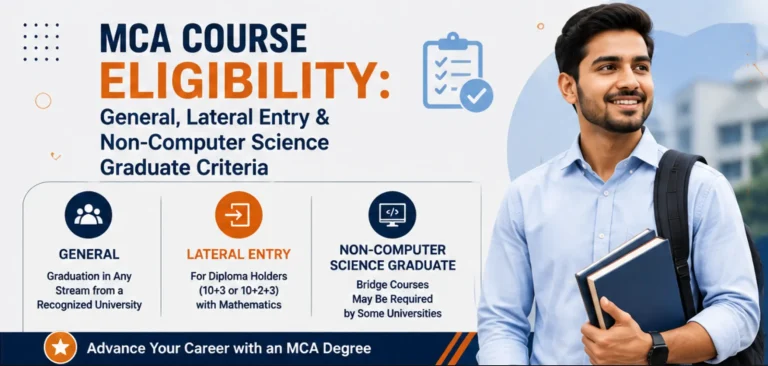
MCA course eligibility can feel confusing because “Am I eligible?” may actually mean three different things: whether you…
Read More →
Karan, a BCA graduate in Bhubaneswar, wants an MCA that strengthens his technical skills without leaving work. MCA…
Read More →
If you are like Priya, a BCA graduate working in IT support, the MCA course duration can affect…
Read More →
Completing an MCA can feel like reaching a major milestone, but it often creates a new question: what…
Read More →
BCA MCA Integrated Course: Admission, Eligibility, Syllabus & Career Scope For students who already know they want a…
Read More →
A full-time job does not automatically rule out postgraduate study, but it changes what makes an MCA practical.…
Read More →