





MBA in AI for Business Course Details, Admission, Eligibility
Artificial intelligence is changing how organisations forecast demand, personalise customer journeys, manage risk and automate decisions. An MBA…
Read More →

You have probably reached a familiar point. Perhaps you have three or four years of work experience and keep getting passed over for team lead roles that ask for a management qualification. Perhaps you graduated recently and every interesting job posting seems to prefer an MBA. Or you work in the public sector, where the next grade requires a recognised postgraduate degree. Whichever situation you’re in, you are now asking the same question that thousands of professionals in India ask each year: Is an online MBA worth it?
For most people, the answer comes down to return on investment. Online MBA fees at a UGC-entitled university typically range between ₹60,000 and ₹3,00,000, while MBA-level roles in India commonly pay ₹4–₹12 LPA at entry and mid levels. This means many learners recover the programme cost within one to two salary revisions. This guide breaks down the ROI, career outcomes, salary growth, and online MBA fees to help you decide whether an online MBA is worth it for your career goals.
If you are a working professional, your real worry is probably this: will my manager and future employers take an online degree seriously, or will I spend two years studying for a qualification that gets quietly discounted in interviews? A decade ago, that concern was justified because distance qualifications carried a stigma. That has largely gone. Degrees from universities approved by the UGC and its Distance Education Bureau (DEB) have the same legal validity as on-campus degrees and are accepted for private-sector jobs, government recruitment, and further study, including PhD admission.
Hiring patterns explain the shift. Companies in IT, BFSI, consulting, and e-commerce recruit for roles such as business analyst, marketing manager, and financial analyst based on skills and interview performance, and an online MBA from a recognised university clears the qualification bar for these roles. If you are an IT professional with five years of experience hoping to move into a team lead or delivery manager position, the degree matters less for where it was studied and more for whether it is recognised and whether you can apply what it taught you.
Consider three people who typically sit in the same online MBA batch. A software developer with five years of experience who cannot afford to resign, because a full-time MBA would mean ₹10–₹20 lakh in lost salary on top of the fee. A sales executive who travels three days a week and needs recorded lectures and weekend classes to keep pace with the semester. And a government employee whose promotion depends on a recognised postgraduate qualification, but whose posting makes campus study impossible.
Each of them chose the online route for a different reason, and together those reasons explain its growing popularity: you keep earning while you study, so your real cost is only the fee; you study around your job rather than instead of it; and options such as Zero Cost EMI spread even that fee across the course. If your week already feels full, this format is built for you.
ROI on an MBA is simple to estimate: compare what you spend with your salary afterwards.
Suppose you currently earn ₹5 LPA and enrol in a programme costing ₹1,75,000. If the MBA helps you move into a managerial role at ₹8 LPA, the annual gain of ₹3 lakh recovers the entire fee in under eight months. Even a modest post-MBA increment of ₹1–₹1.5 LPA pays back the investment within two years, after which every increment is pure return.
| Factor | Full-Time MBA | Online MBA |
| Typical fee | ₹8–₹25 lakh | ₹60,000–₹3 lakh |
| Salary lost during study | ₹10–₹20 lakh | Nil |
| Payback period | 3–6 years | 1–2 years |
| Career disruption | 2 years | None |
Because the cost base is so much lower and you keep earning throughout, the online route usually delivers a faster payback than a full-time MBA, even when the starting salary after a full-time programme is higher.
The table below maps a typical fee against the salary progression MBA graduates see in India.
| Career Stage | Typical Salary Range | Cumulative Gain vs a ₹1.75 Lakh Fee |
| Entry-level (0–2 years post-MBA) | ₹3–₹6 LPA | Fee recovered within 1–2 increments |
| Mid-career (3–8 years) | ₹7–₹15 LPA | 4–8× the fee, annually |
| Senior roles (8+ years) | ₹15 LPA and above | The fee becomes negligible |
Read this way, the fee is a one-time cost compared to a salary uplift that compounds over the rest of your career. The main risk to ROI is not the degree itself but choosing an unrecognised university or a specialisation with weak demand, both of which are avoidable.
Your specialisation should follow your career problem, not the other way round. If you enjoy working with numbers and want a path into banking or corporate finance, Financial Management is a good fit. If you are a marketing executive aiming for brand or digital roles, Marketing Management builds directly on what you already do. HR suits those drawn to people management and organisational work. And if you come from a technical background, or your role increasingly expects data-backed decisions, IT & Business Analytics is currently the strongest bet for ROI, with companies across IT, BFSI, and e-commerce hiring business analysts at ₹4–₹8 LPA even at the entry level.
Learning happens through live and recorded classes, supported by Harvard Business School certifications, HRFY.ai interview preparation, and Grammarly access. Career services include counselling, resume guidance, virtual job fairs, and alumni networking, which directly address the placement question most online learners worry about.
Two people can complete the same programme and see very different outcomes. One finishes with a degree certificate; the other finishes with a degree, a portfolio of applied projects, two certifications, and a network that produces interview calls. The degree sets the qualification bar, but what you do around it decides the salary outcome. A few habits separate graduates who see quick returns from those who do not.
Choose your specialisation for demand, not comfort. Business Analytics, Finance, and Digital Marketing currently offer the fastest routes to interviews because companies are actively hiring for data and digital roles. If you are a commerce graduate unsure between HR and Finance, check job portals for openings in your city before deciding.
Apply what you learn immediately. If you are working, volunteer for projects that use your MBA subjects, such as preparing a budget, analysing campaign data, or leading a small team. These become concrete interview stories, which matter more to recruiters than marks.
Add one or two certifications. A course in Excel-based financial modelling, Google Ads, or Power BI alongside your MBA signals that you are job-ready, and it costs little compared to the salary difference it can make.
Use the career support you are paying for. Attend virtual job fairs, get your resume reviewed, and practise interviews before you need them. Learners who treat placement support as part of the course, rather than an afterthought, consistently convert more offers.
Finally, build your network deliberately. Connect with classmates, faculty, and alumni on LinkedIn during the programme, not after it. Referrals fill a large share of management roles, and an online MBA cohort spread across industries is a networking asset that a campus batch cannot match.
Yes, provided the university is UGC-DEB recognised and you choose a specialisation with genuine hiring demand. The maths is favourable: a fee of ₹1–₹2 lakh against a salary path that moves from ₹3–₹6 LPA at the entry level to ₹15 LPA and beyond in senior roles, with no income lost while you study. Whether you are a fresh graduate building a management career, a professional preparing for promotion, or a government employee seeking a recognised qualification, the online MBA is one of the highest-ROI investments available in Indian higher education today. If you want a programme that combines recognition, affordability, and career support, the JIIT Online MBA is a strong place to start.

Yes. MBA graduates in India typically move from ₹3–₹6 LPA at entry level to ₹7–₹15 LPA mid-career, with the increase driven by specialisation, skills, and experience.
With fees between ₹60,000 and ₹3 lakh and no salary lost during study, most learners recover their investment within one to two years of completing the programme.
Yes. Degrees from UGC-DEB recognised universities are valid for private jobs, government recruitment, and higher education, and employers increasingly treat them on par with on-campus MBAs.
Neither is universally better. A regular MBA suits full-time students; an online MBA offers faster payback and zero career disruption for working professionals and budget-conscious learners.
IT & Business Analytics, Finance, and Marketing currently offer the strongest hiring demand, with business analyst and financial analyst roles paying ₹4–₹12 LPA across industries.

Artificial intelligence is changing how organisations forecast demand, personalise customer journeys, manage risk and automate decisions. An MBA…
Read More →
An MBA in Business Management is useful for learners who want broad management capability before committing deeply to…
Read More →
For professionals and graduates interested in cross-border markets, trade, global strategy or multinational operations, an MBA in International…
Read More →
An MBA in Sports Management can suit learners who want to work on the business side of sport…
Read More →
An MBA in Entrepreneurship helps learners understand how ideas become viable businesses, how ventures are financed and how…
Read More →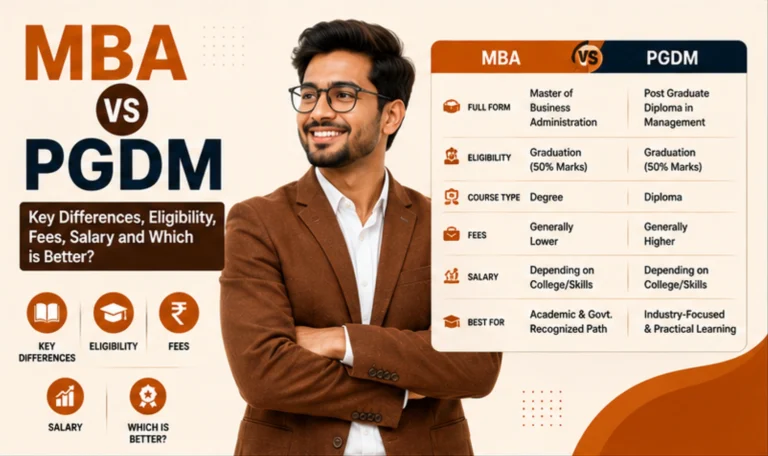
MBA vs PGDM at a glance: An MBA is a university-awarded postgraduate degree, while a PGDM is a…
Read More →
Priya is a 30-year-old marketing operations professional. She prepares campaign reports, tracks conversion numbers and works with dashboards…
Read More →
Move from coordinating tasks to leading projects that shape business outcomes Aman is a 29-year-old site engineer with…
Read More →
A practical comparison framework for prospective students evaluating recognised online MBA programmes in India. The right online MBA…
Read More →
Rahul has been working as a software engineer for four years. He knows moving into a managerial role…
Read More →