





MBA in AI for Business Course Details, Admission, Eligibility
Artificial intelligence is changing how organisations forecast demand, personalise customer journeys, manage risk and automate decisions. An MBA…
Read More →

At 34, Rohan has spent eight years in operations and now manages a team of 12. He wants to move into a business-head role, but leaving his job for a full-time MBA would interrupt his income and career momentum. His questions are practical: Does he have enough experience for an Executive MBA? Will the syllabus help him manage budgets and strategy, not only operations? Can he complete the programme alongside work, and is the investment justified? This guide follows decisions like Rohan’s to explain eligibility, syllabus, formats, career value and return on investment without relying on guaranteed outcomes.
An Executive MBA is a management programme designed for professionals who already have substantial workplace experience and want to prepare for wider managerial or leadership responsibilities. For someone like Rohan, the value is not in relearning how organisations function. It is in building the strategic, financial and cross-functional knowledge needed to move beyond a specialised operational role. Compared with a regular MBA, an Executive MBA generally places greater emphasis on decision-making, organisational leadership and the application of management concepts to live business situations. Formats vary, so professionals should compare the exact qualification, recognition, class schedule and admission criteria rather than assuming every programme offers the same experience.
| Particular | What to expect |
|---|---|
| Course duration | Varies by institution; often about 12 to 24 months |
| Mode | Online, weekend, hybrid or campus-based |
| Eligibility | Usually a recognised bachelor’s degree plus relevant work experience |
| Work experience | Programme-specific; often required |
| Fees | Vary considerably by institution and delivery model |
| Career stage | Typically experienced professionals preparing for broader managerial responsibilities |
| Career outcomes | Depend on prior experience, performance, industry conditions and programme quality |
Most institutions require a bachelor’s degree from a recognised university. Minimum marks and accepted degree formats differ. Rohan, for example, should not assume that eight years of experience automatically overrides an institution’s academic requirement. He must compare his graduation record with the published eligibility conditions before paying an application fee.
Work experience is a defining feature of many Executive MBA programmes, but the requirement is not uniform. Rohan’s eight years of full-time experience may place him within the intended cohort for many programmes, particularly if he can demonstrate progression from individual contributor to team manager. Applicants should also confirm whether entrepreneurial, part-time or family-business experience is counted and whether the institution evaluates only the number of years or also the quality of responsibility held.
Entrance requirements depend on the institution and programme. Some programmes assess academic history, work experience, an interview or a statement of purpose, while others may ask for CAT, GMAT or Executive Assessment scores. Rohan therefore needs to separate programmes he can apply to immediately from those that require several months of test preparation. The latest policy should be verified on the institution’s official website.
Institutions may assess leadership exposure, functional responsibility, career progression and the reason for pursuing the programme. Rohan’s application would be stronger if he explains a specific gap, such as limited exposure to corporate finance and enterprise strategy, and connects it with his goal of taking responsibility for a larger business unit. A statement that merely says he wants career growth provides little evidence of programme fit.
The syllabus of an MBA usually combines management foundations with advanced subjects related to strategy, leadership and business transformation. Rohan should read it as a capability map rather than a list of subjects. Finance should help him understand budgets and investment decisions, strategy should help him evaluate markets and competition, and leadership modules should prepare him to manage larger, cross-functional teams. The exact structure varies, but most programmes include the following components:
Core modules may cover economics, accounting, finance, marketing, operations, organisational behaviour and strategic management. For Rohan, the strongest curriculum would not repeat operational concepts he already uses. It would help him connect operations with pricing, profitability, customer demand, workforce decisions and organisational strategy.
Electives allow learners to build depth in areas such as finance, business analytics, marketing, human resources, operations, entrepreneurship or digital transformation. Rohan may be tempted to choose Operations because it matches his current role. However, Finance, Strategy or Business Analytics could be more useful if his next role requires broader commercial decisions. The right elective should support the role he wants, not simply confirm what he already knows.
Many programmes include case studies, simulations, consulting assignments or a capstone project. These components become valuable when they allow learners to solve a real workplace problem. Rohan could, for example, use a capstone to analyse capacity planning, reduce process delays or evaluate the financial case for automation in his organisation. He should check whether the programme provides faculty feedback and whether employer data can be used safely.
A typical semester-wise structure may look like this:
| Semester | Core subjects | Electives | Applied learning |
|---|---|---|---|
| I | Economics, accounting, marketing and organisational behaviour | Usually limited | Case analysis or reflective assignments |
| II | Finance, operations, analytics and leadership | Introductory electives may begin | Applied project or simulation |
| III | Strategy, change management and digital transformation | Major specialisation electives | Live project or consulting assignment |
| IV | Governance, global business and integration | Advanced electives or entrepreneurship | Capstone project, dissertation or business plan |
This table is illustrative, not a universal syllabus. Applicants should compare the official curriculum, elective availability, assessment pattern and project requirements of the specific programme they are considering.
An Executive MBA may support progression into roles with greater responsibility for teams, budgets, strategy or business performance. For Rohan, a realistic first outcome may be an expanded operations role or responsibility for a larger region before a business-head designation. The degree does not guarantee a promotion, because outcomes also depend on performance, organisational structure, industry demand and available opportunities.
Professionals may use the degree to move from specialist work into managerial roles within finance, marketing, operations, human resources, analytics or technology. Rohan’s move from operations manager to general management would require evidence that he can understand commercial and people decisions beyond his current function. Relevant projects, cross-functional assignments and internal visibility may matter as much as the qualification itself.
Some learners pursue an Executive MBA to change functions or industries. Such transitions are possible, but they are usually harder than progressing within a familiar sector. If Rohan wanted to move from manufacturing operations into consulting, he would need more than an Executive MBA title. He would also need credible project work, problem-solving evidence, industry knowledge, networking and a clear explanation of his transferable experience.
| Feature | Online Executive MBA | Weekend or hybrid Executive MBA | Regular MBA |
|---|---|---|---|
| Typical learner | Experienced professional needing location flexibility | Experienced professional able to attend scheduled campus sessions | Early-career learner or career switcher seeking full-time immersion |
| Work experience | Commonly required | Commonly required | May not be required |
| Learning mode | Online live and recorded learning | Scheduled campus sessions with online support | Predominantly full-time, campus-based learning |
| Flexibility | Usually high, subject to attendance and exam rules | Moderate | Limited for full-time programmes |
| Cost | Varies by institution and format | Varies and may include travel or accommodation | Often includes a larger opportunity cost because of time away from work |
| Best fit | Professionals prioritising continuity of employment and flexibility | Professionals valuing face-to-face peer interaction | Learners seeking internships, campus networks and a major career reset |
The return on an Executive MBA cannot be judged through a universal salary figure or a promised payback period. Rohan should calculate the decision using his own situation: total programme cost, financing charges, weekly study time, likely effect on family commitments and the specific career opportunity he is targeting. Benefits may include eligibility for broader roles, stronger decision-making skills, a relevant peer network or greater confidence in cross-functional discussions. He should ask institutions for programme-specific career data and distinguish verified evidence from marketing claims.
| Evaluation area | Questions Rohan should ask |
|---|---|
| Total investment | What are the full tuition, tax, financing, travel and technology costs, and can I afford them without assuming a promotion? |
| Career relevance | Which subjects and projects will prepare me to move from operations management into broader business responsibility? |
| Evidence of outcomes | Does the institution publish verifiable outcomes for professionals with experience comparable to mine? |
| Opportunity cost | Can I sustain the weekly workload during reviews, travel and family commitments? |
| Network value | Will I interact meaningfully with peers, alumni, faculty and mentors from functions beyond operations? |
An Executive MBA is most useful when a learner has enough work experience to connect management theory with real decisions and a clear reason for pursuing the qualification. Rohan is a plausible fit because he has progressed into team management, knows the limitations of his current functional expertise and can define the broader role he wants. The same programme may be unsuitable for someone at a different stage.
For Rohan, an Executive MBA may be a sensible investment if it closes identifiable gaps in finance, strategy and leadership while allowing him to remain employed. It would be a poor decision if he selected a programme only for the Executive MBA label, expected an automatic salary increase or could not sustain the weekly workload. Experienced professionals should reach the same decision by comparing recognition, curriculum, peer profile, delivery format, total cost and evidence of outcomes against one clearly defined next role. The programme is a strong fit only when its learning can be applied to the responsibilities the professional is preparing to take on.
An Executive MBA is a management programme for experienced professionals who want to strengthen strategic, leadership and cross-functional business skills while continuing their careers. For a manager like Rohan, it can provide the broader business knowledge needed to progress beyond a single function.
MBA Eligibility varies by institution. Most programmes require a recognised bachelor's degree and relevant work experience, while some may also require an entrance test, interview or statement of purpose. Applicants should evaluate both the number of years worked and the responsibility they have handled.
Many Executive MBA programmes are designed for working professionals through online, weekend or hybrid delivery. Rohan would still need to check whether evening classes conflict with work reviews, how much attendance is compulsory and whether he can consistently reserve study time each week.
An Executive MBA generally serves experienced professionals and places greater emphasis on leadership, strategy and workplace application. A regular MBA usually serves early-career learners and provides broader foundations, internships and campus-based learning. The suitable option depends on career stage, not only age.
Validity depends on the institution, the exact qualification offered and its applicable regulatory status. A professional like Rohan should verify the specific programme through official institutional and regulatory sources rather than relying on a counsellor's verbal assurance.
Programme duration varies. Many Executive MBA programmes are completed in approximately one to two years, but the academic calendar and credit structure should be checked for the specific institution.
There is no reliable universal salary figure. Rohan's outcome would depend on his existing salary, experience, industry, performance, location, target role and the organisation's promotion structure. Programme-specific, independently verifiable data is more useful than broad market averages.
It can be worthwhile when it develops capabilities required for a specific next role and the cost is manageable. Rohan should test the decision against realistic scenarios, including no immediate promotion, rather than assume that the programme will pay for itself within a fixed period.
Some do and some do not. Institutions may use academic merit, work experience, interviews or tests such as CAT, GMAT or the Executive Assessment. The latest admission policy should be verified directly.
The most suitable specialisation is the one aligned with the learner's experience and target role. Rohan may gain more from Finance, Strategy or Analytics than from repeating Operations, because his objective is to prepare for wider business responsibility. Another professional may reach a different conclusion based on a different capability gap.

Artificial intelligence is changing how organisations forecast demand, personalise customer journeys, manage risk and automate decisions. An MBA…
Read More →
An MBA in Business Management is useful for learners who want broad management capability before committing deeply to…
Read More →
For professionals and graduates interested in cross-border markets, trade, global strategy or multinational operations, an MBA in International…
Read More →
An MBA in Sports Management can suit learners who want to work on the business side of sport…
Read More →
An MBA in Entrepreneurship helps learners understand how ideas become viable businesses, how ventures are financed and how…
Read More →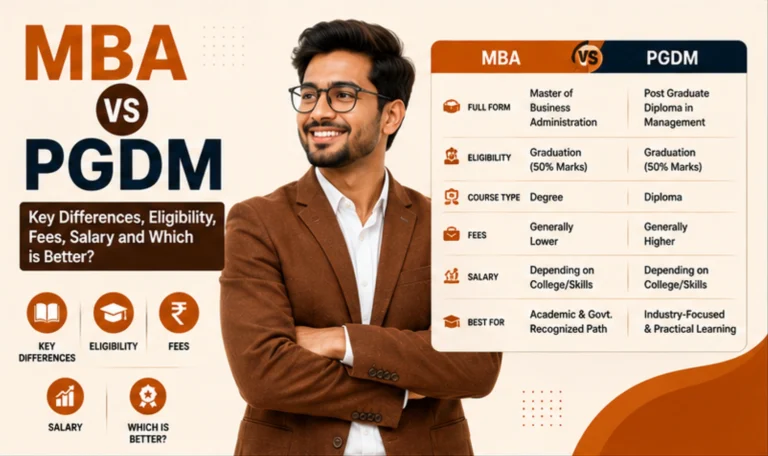
MBA vs PGDM at a glance: An MBA is a university-awarded postgraduate degree, while a PGDM is a…
Read More →
Priya is a 30-year-old marketing operations professional. She prepares campaign reports, tracks conversion numbers and works with dashboards…
Read More →
Move from coordinating tasks to leading projects that shape business outcomes Aman is a 29-year-old site engineer with…
Read More →
You have probably reached a familiar point. Perhaps you have three or four years of work experience and…
Read More →
A practical comparison framework for prospective students evaluating recognised online MBA programmes in India. The right online MBA…
Read More →