
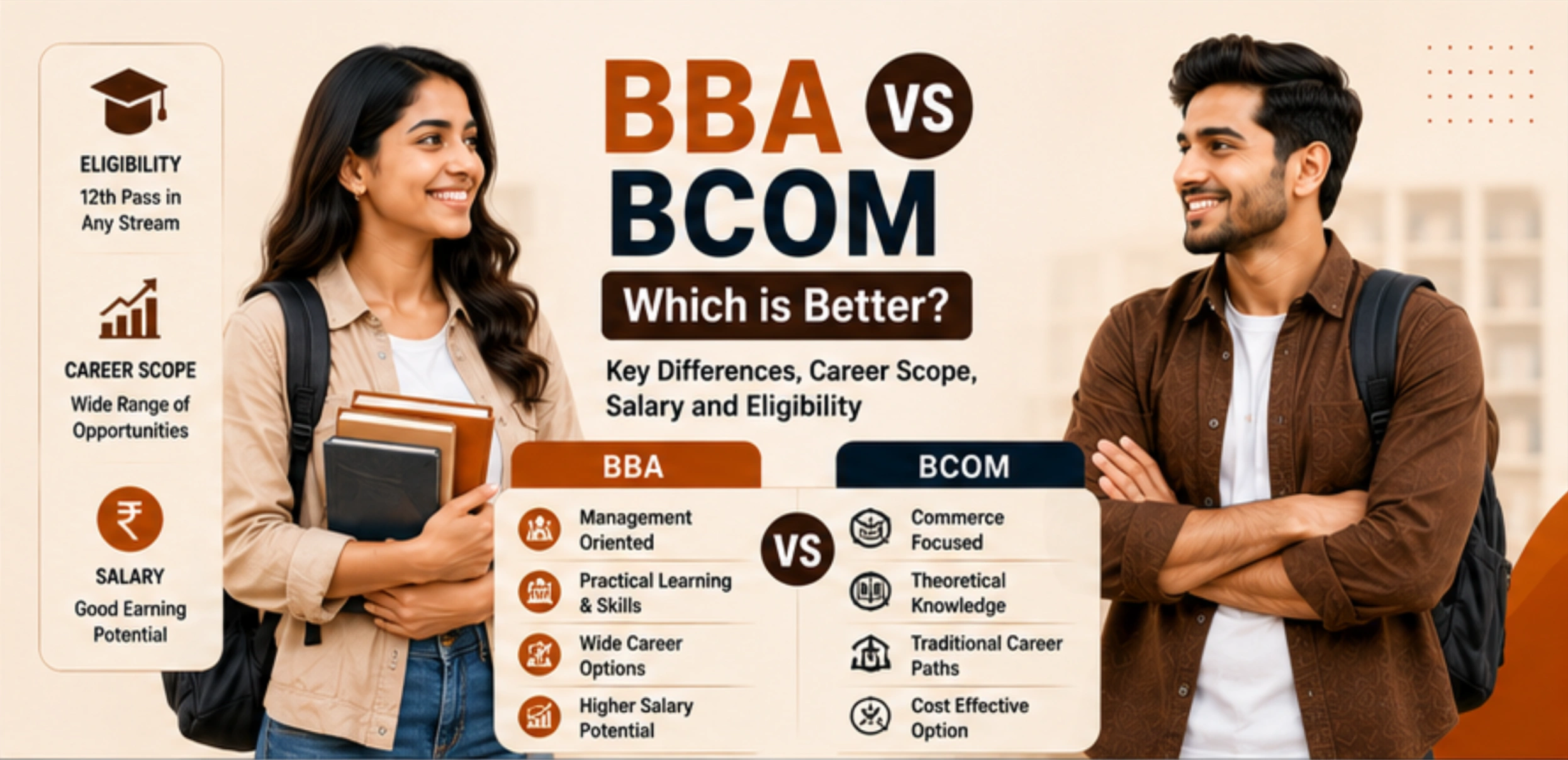
Choosing between BBA and BCom is less about which degree is “better” and more about the kind of work you want to prepare for. BBA is management-oriented, while BCom is rooted more deeply in commerce, accounting and finance. This guide compares the two so you can decide which best fits your interests, skills, and higher-study plans.
For someone like Riya, a Class 12 Commerce student who enjoys both business presentations and accountancy, the choice isn’t obvious. Online BBA Program generally suits learners drawn to management, marketing, HR, operations or entrepreneurship. BCom usually suits students who want a stronger grounding in accounting, taxation, banking, or professional finance pathways. The answer to BBA or BCom which is better therefore depends on what you want to learn next, not on a universal ranking of the two degrees.
If you are already considering an MBA, both routes can lead there. BBA may give earlier exposure to management subjects, while BCom can provide a stronger foundation in finance and accounting. Your college, curriculum, internships, projects, and later qualifications will matter more than the degree label alone.
The table below summarises the practical BBA vs BCom differences that matter most when shortlisting a course. Individual universities may structure subjects, duration, fees and specialisations differently, so verify the current programme page before applying.
| Parameter | BBA | BCom |
|---|---|---|
| Course focus | Management, marketing, HR, operations and business decision-making | Commerce, accounting, finance, taxation and banking |
| Typical duration | 3 years in many universities | 3 years in many universities |
| Eligibility | 10+2; university-specific marks and subject rules apply | 10+2; university-specific marks and subject rules apply |
| Curriculum style | Management concepts, presentations, projects and case-based learning | Commerce concepts, accounting practice, economics and quantitative work |
| Specialisation scope | May include finance, marketing, HR or analytics | May include accounting, finance, taxation or banking |
| Skills developed | Communication, teamwork, business analysis and decision-making | Numerical analysis, accounting, financial interpretation and commercial reasoning |
| Fees | Varies significantly by institution and mode | Varies significantly by institution and mode |
| Career direction | Management support, marketing, sales, HR, operations and business roles | Accounting, banking, finance, audit, taxation and commerce roles |
| Higher studies | MBA, specialised master’s programmes and professional certifications | MCom, MBA, CA, CMA, CS and other finance pathways |
| Better fit for | Students interested in management and business functions | Students interested in commerce, finance and accounting |
Career outcomes depend heavily on the institution, location, internships, technical or professional skills and further qualifications. A degree alone does not guarantee a particular salary or employer. This comparison focuses on the kinds of pathways each course can support.
| Aspect | BBA | BCom |
|---|---|---|
| Popular early-career roles | Management trainee, marketing executive, sales executive, HR coordinator, business operations associate | Accounts executive, audit assistant, banking associate, finance operations executive, tax assistant |
| Salary context | Varies by role, employer, city, skills and experience | Varies by role, employer, city, skills and experience |
| Common sectors | Retail, services, technology, consulting support, FMCG and startups | Banking, financial services, accounting, audit, taxation and commerce |
| Government pathways | Graduates may apply for eligible graduate-level competitive examinations | Graduates may apply for eligible graduate-level competitive examinations, including banking-related exams |
| Entrepreneurship value | Useful for understanding management, marketing, people and operations | Useful for understanding accounts, finance and commercial fundamentals |
| Higher studies | MBA and other management-focused postgraduate routes | MCom, MBA and professional qualifications such as CA, CMA or CS |
The difference between BBA and BCom often becomes more visible after graduation. BBA graduates may move towards functional management or an MBA, while BCom graduates may deepen into accounting, finance or professional qualifications. Neither progression is automatic; experience and additional credentials shape outcomes.
Riya can make the choice more confidently by testing the decision against her preferred subjects and long-term goals rather than relying on salary comparisons alone:
For students leaning towards management, JIIT Online’s current BBA is a three-year, six-semester programme. Its published pathways include Finance, Marketing, Human Resources and Analytics. Check eligibility and fee information on the current programme page before applying.
The BBA vs BCom decision is a fit question rather than a prestige contest. Choose BBA for management-oriented learning and BCom for deeper foundations in commerce and finance. If you are still asking which is better, BBA or BCom, compare the actual syllabus, career direction and higher-study plan before deciding.
BBA focuses more on management and business functions, while BCom emphasises commerce, accounting and finance. The right choice depends on your preferred subjects and career direction.
Neither degree guarantees a higher salary. Pay depends on role, employer, skills, location, experience and further qualifications, so compare career pathways rather than headline salary figures.
No. Both can lead to an MBA if you meet the university’s eligibility criteria. BBA may provide earlier management exposure, while BCom can strengthen finance fundamentals.
Both offer viable entry-level routes. BBA commonly leads towards management-support and business roles, while BCom is more closely aligned with accounting, banking and finance positions.
BCom often provides a stronger foundation in accounting and finance. A BBA with finance-focused coursework can also be relevant, especially for business-facing banking or financial-services roles.
Choose BBA if you're interested in management, marketing, HR, or entrepreneurship. Choose BCom if you prefer accounting, finance, taxation, banking or professional commerce qualifications.