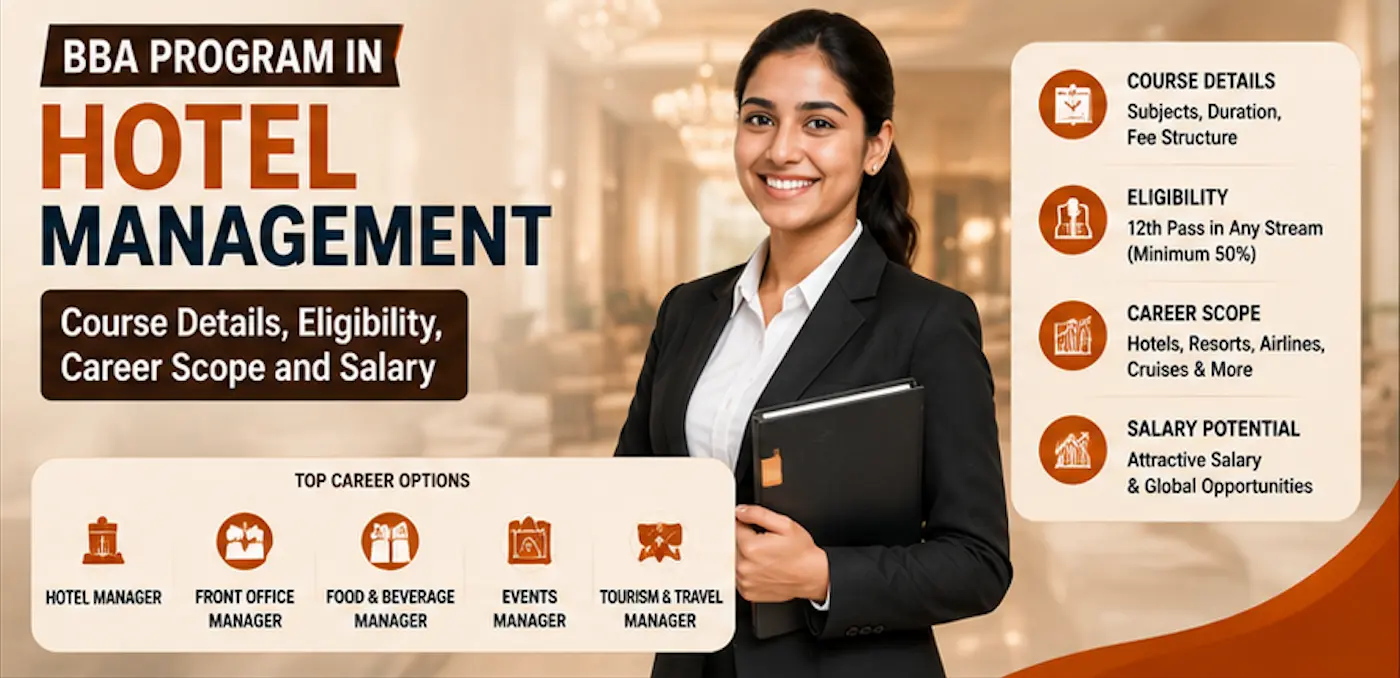
A BBA in Hotel Management suits students who want to understand the business side of hospitality, including hotel operations, guest experience, revenue, events, and service management. For Anshika, who enjoys organising experiences but does not want a culinary career, the key question is whether a management-led hospitality degree matches her strengths. This guide explains eligibility, syllabus, career scope and progression considerations.
A BBA in Hotel Management is generally a three-year undergraduate programme that combines business fundamentals with hospitality-focused learning. Depending on the university, subjects may include front-office operations, food and beverage management, housekeeping, hospitality marketing, finance, revenue management and customer experience. The programme is usually aimed at students interested in supervisory, commercial or administrative roles rather than chef training. Eligibility and admission rules vary by institution, so applicants should check the exact Class 12 requirement and programme approval before applying. For Anshika, the useful distinction is between a management-focused route and a more operations-intensive hotel-management degree such as a BHM.
Students may consider a BBA in Hotel Management when they want business education within a hospitality context. An online format can add flexibility, but learners should verify whether the programme includes practical exposure that cannot be replicated fully online.
The exact syllabus differs across universities. The table below is an illustrative six-semester structure showing the mix of business and hospitality subjects a BBA in Hotel Management may cover. It is not the JIIT Online BBA syllabus.
| Semester | Illustrative subjects |
|---|---|
| I | Principles of Management, Business Communication, Financial Accounting, Introduction to Hospitality |
| II | Organisational Behaviour, Marketing Fundamentals, Front Office Operations, Food and Beverage Fundamentals |
| III | Hospitality Operations, Housekeeping Management, Human Resource Management, Hospitality Finance |
| IV | Revenue Management, Event Management, Tourism Management, Customer Experience and Service Quality |
| V | Hospitality Sales, Digital Marketing, Resort Management, Business Analytics, Elective |
| VI | Strategic Hospitality Management, Entrepreneurship, Capstone Project, Internship or industry project |
Career outcomes after a BBA in Hotel Management depend on practical exposure, communication skills, location and employer requirements. Representative roles include the following; salary should be checked using current role- and city-specific data rather than treated as guaranteed by the degree.
| Role | Typical work area | Salary context |
|---|---|---|
| Front Office Executive / Supervisor | Guest services, reservations, front-desk operations | Varies by employer, city, and experience |
| Food and Beverage Executive | Restaurant or banquet operations, service coordination | Varies by employer and responsibility |
| Revenue or Reservations Associate | Pricing support, occupancy, booking channels and reporting | Varies with analytical skill and employer |
| Event Operations Executive | Venue, vendor and guest coordination | Often project- and employer-dependent |
| Hospitality Sales Executive | Corporate sales, partnerships and account support | May include performance-linked pay |
| Restaurant or Outlet Supervisor | People, service and day-to-day outlet operations | Varies by brand and location |
| Guest Experience Executive | Service recovery, feedback and customer experience | Varies by property and role scope |
Potential employers include hotels, resorts, restaurant groups, event companies, travel platforms and hospitality-service businesses. Higher-study options can include an online MBA, hospitality-management postgraduate study or specialised certifications. Students should verify whether a course provides internships or practical projects, because these can be especially important in hospitality hiring.
A BBA in Hotel Management can be a useful route for students who want business responsibilities within hospitality rather than a culinary pathway. Anshika should compare curriculum depth, practical exposure and employer access before deciding. JIIT Online offers an online BBA program, but Hotel Management is not currently listed as a named specialisation.
JIIT Online note: The current JIIT Online BBA is a three-year, six-semester programme with specialisations in Finance, Marketing, HR and Analytics. Its published eligibility requires passing Class 12 in all subjects with at least 40% marks, and the listed programme fee is ₹1,39,000. Hotel Management is not currently listed as a named specialisation, so students specifically seeking that track should compare a dedicated programme elsewhere rather than assume it is part of JIIT Online BBA.
It can be suitable for students interested in hospitality operations, sales, revenue, events or guest experience. Career outcomes depend on practical exposure, communication skills and employer requirements.
Typical subjects include business management, front-office operations, food and beverage, housekeeping, hospitality marketing, finance, revenue management, events and customer experience. Curricula vary by university.
There is no single reliable programme-wide salary figure. Pay varies by role, city, employer, internships and prior experience, so current role-specific salary data should be checked.
Validity depends on the university and whether it is entitled to offer the specific online programme for the relevant academic period. Applicants should verify current UGC information before enrolling.
A BBA in Hotel Management is generally more management-oriented, while BHM programmes typically provide deeper operational hospitality training and may include greater practical exposure to hotel functions.
Graduates may explore hotels, resorts, restaurant groups, events, travel services, hospitality technology and related service businesses, subject to the skills and experience required for each role.
International opportunities are possible, but a degree alone does not guarantee them. Employers may require experience, language capability, local licensing or work authorisation depending on the country and role.