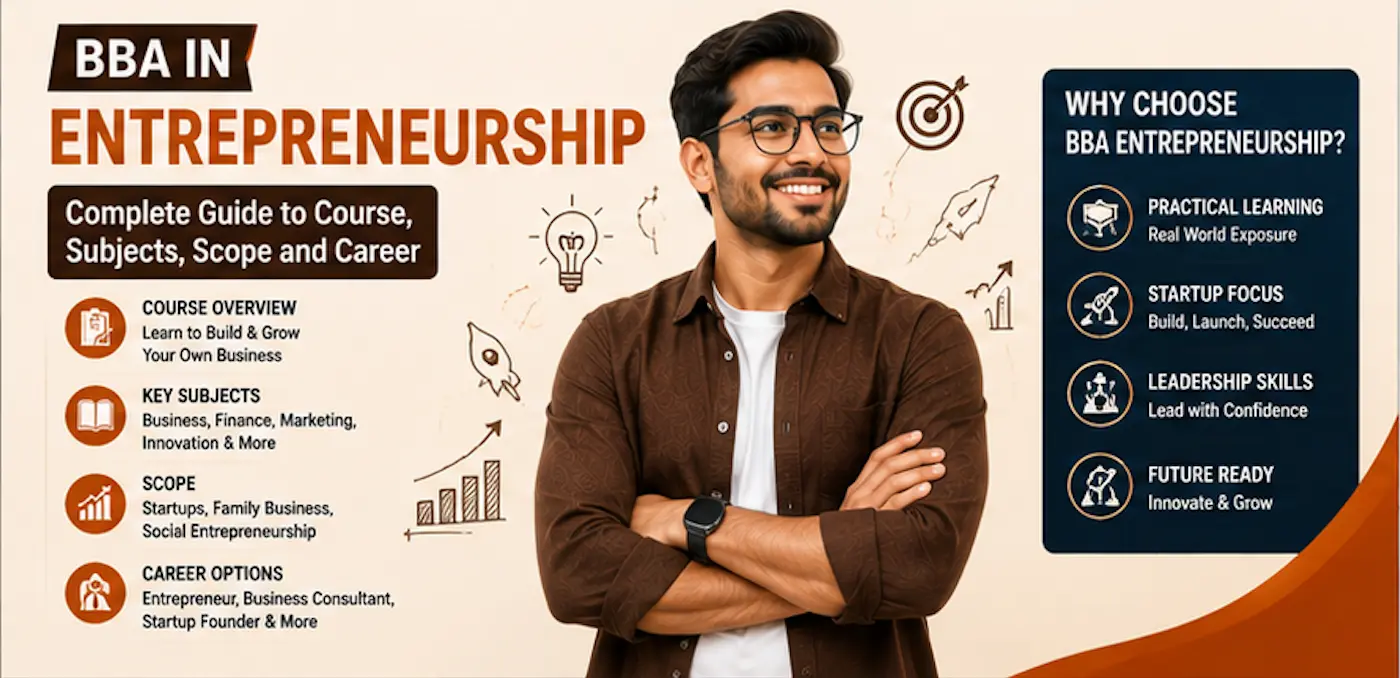
A BBA in Entrepreneurship can suit students who want to understand how ideas become viable businesses, whether they plan to launch a venture, contribute to a family enterprise or work with startups. For Tavishi, who already helps in her family’s retail business, the key question is whether a specialised entrepreneurship pathway adds enough practical value. This guide explains course structure, eligibility, subjects, admission and realistic career directions for BBA entrepreneurship learners.
A BBA in Entrepreneurship is typically a three-year undergraduate management degree that combines business fundamentals with subjects linked to venture creation, opportunity evaluation, finance, marketing and business-model development. The aim is not to guarantee that graduates will become founders, but to help them understand how businesses are planned, tested and managed. It may suit aspiring founders, family-business successors and students interested in startup roles. Compared with a general BBA, the main difference is a stronger emphasis on entrepreneurship. JIIT Online does not currently list Entrepreneurship as a named BBA specialisation, although its Online BBA curriculum includes Entrepreneurial Development in Semester III.
For Tavishi, this matters because the course should improve how she assesses customers, costs and growth decisions—not simply give her an “entrepreneur” label.
The exact syllabus varies by university. The table below is an illustrative structure showing how a BBA entrepreneurship curriculum may combine core management study with venture-focused learning; it should not be read as JIIT Online’s published semester plan.
| Semester | Illustrative subjects |
|---|---|
| I | Principles of Management, Financial Accounting, Business Communication, Business Mathematics, Foundations of Entrepreneurship |
| II | Marketing Management, Business Statistics, Organisational Behaviour, Economics, Business Environment |
| III | Financial Management, Human Resource Management, Operations Management, Startup Finance, Opportunity Evaluation |
| IV | Business Research Methods, Business Analytics, Product Thinking, Startup Marketing, Business Model Design |
| V | Strategic Management, Venture Financing, Family Business Management, Digital Marketing, Elective |
| VI | Scaling Ventures, Business Planning, Legal Aspects of Business, Capstone Project, Internship or applied project |
Career outcomes after a BBA entrepreneurship degree depend heavily on practical experience, the strength of projects and the type of organisation joined. Entrepreneurship study can support both self-employment and employed roles, but it does not guarantee funding, a successful venture or a particular salary.
| Career direction | Where it may apply | What matters most |
|---|---|---|
| Founder or co-founder | Own venture | Problem validation, financial discipline, execution |
| Family-business role | Family enterprise | Operations, succession planning, market understanding |
| Business development executive | Startups and growth-stage firms | Sales, negotiation, customer research |
| Startup product associate | Digital or consumer businesses | User research, product thinking, data interpretation |
| Marketing executive | Startups and growing brands | Campaign planning, digital tools, customer insight |
| Incubator programme associate | Incubators and entrepreneurship cells | Programme coordination, founder support, communication |
| Consulting or research analyst | Small consulting and advisory firms | Research, analysis, presentation skills |
Potential employers vary widely, so students should check current openings rather than treating any brand as a guaranteed recruiter. Higher-study routes can include an MBA in Entrepreneurship, Finance, Marketing or another management area aligned with the venture or role they want to pursue.
A BBA entrepreneurship pathway can be useful when you want structured exposure to venture creation, family business or startup work. Compare the actual curriculum, projects and mentoring before enrolling. For Tavishi, JIIT Online’s general BBA may still be relevant because its curriculum includes Entrepreneurial Development, but Entrepreneurship is not currently a named specialisation.
It can be useful for aspiring founders who want structured business knowledge, but success still depends on opportunity selection, execution, market understanding and financial discipline.
Subjects commonly combine management fundamentals with entrepreneurship, startup finance, marketing, business-model development, product thinking and family-business topics. Exact subjects vary by university.
Yes. Online BBA can build useful management foundations, but starting a business also requires a viable idea, customer validation, funding decisions and practical execution.
Options can include business development, startup product or marketing roles, incubator support, family-business responsibilities, consulting support or launching an independent venture.
Yes. BBA graduates can pursue an MBA subject to the chosen institution’s eligibility rules. Entrepreneurship, Finance, Marketing and Analytics are possible postgraduate directions.
It can be relevant because management, finance, marketing and entrepreneurship concepts can support decision-making in a family enterprise, although practical business exposure remains important.