
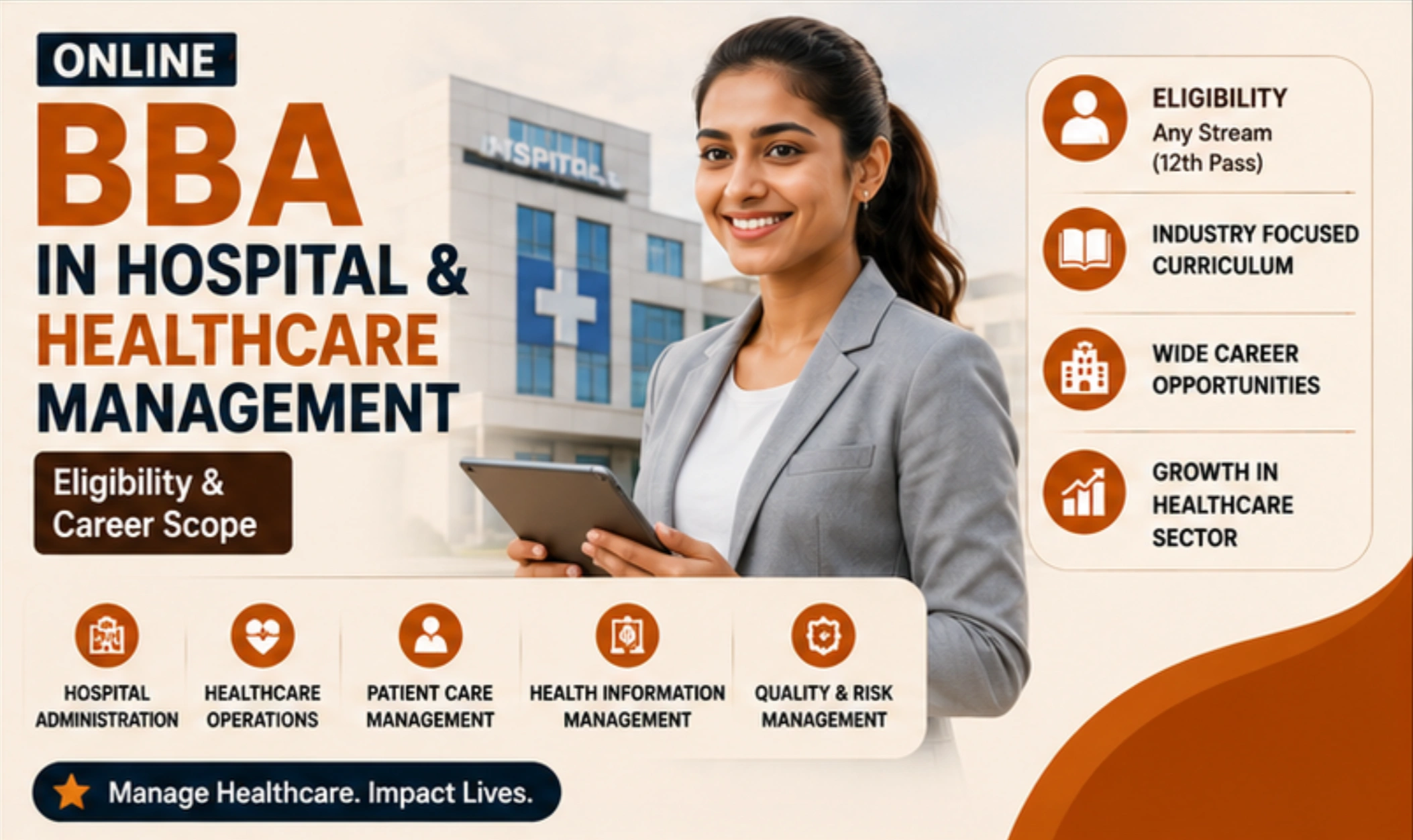
At a glance: A BBA in Hospital and Healthcare Management combines business fundamentals with the operational side of healthcare. It suits students who want to work in hospitals, insurance, diagnostics, or health-tech without entering a clinical profession. Before enrolling, check the exact specialisation, eligibility, syllabus, practical exposure and recognition published by the university.
Rhea, a Class 12 learner interested in healthcare but not in a clinical degree, is weighing that same decision: whether she wants a broad business education or a programme that adds healthcare-specific context from the start.
A BBA in Hospital and Healthcare Management is generally a three-year management degree combining business subjects with healthcare operations, finance, human resources, insurance, ethics and digital health. It prepares learners for non-clinical administrative and business roles, not medical practice. Compared with a general BBA, it adds healthcare-sector context. JIIT Online publishes a three-year, six-semester Online BBA with specialisations in Finance, Marketing, Human Resources and Analytics; Healthcare Management is not listed in the current JIIT project sources.
Online study can make a healthcare-management degree easier to combine with work, internships or other commitments. Programme design matters more than delivery mode alone.
Eligibility differs by institution. Check:
JIIT Online reference: As of 11 August 2026, its general Online BBA requires Class 12 from a recognised board, at least 40% aggregate marks and a pass in all subjects. Its published criteria do not restrict eligibility to one school stream.
For Rhea, that means the first check is whether the chosen healthcare-specific programme accepts her stream and marks, rather than assuming all BBA variants share the same rules.
The exact process varies. A typical online application follows these steps:
For JIIT Online’s general BBA, the current project source describes an online application, document upload, programme-choice review, authorised payment and eligibility verification flow.
This is an illustrative healthcare-management structure, not JIIT Online’s published syllabus. Compare it with the exact curriculum before applying.
| Semester | Illustrative study focus |
| I | Management principles, business communication, accounting, introduction to healthcare |
| II | Organisational behaviour, statistics, hospital administration, healthcare terminology |
| III | Healthcare operations, health economics, finance, human resources |
| IV | Health insurance, healthcare law and ethics, digital health, public-health administration |
| V | Quality management, healthcare marketing, health informatics, elective/project work |
| VI | Strategic healthcare management, entrepreneurship, capstone project or internship |
What matters most: look for a balance between core management subjects and practical healthcare administration, plus opportunities to apply learning through projects or internships.
Graduates may explore non-clinical roles across hospitals, insurers, diagnostics, health-tech and related services. Outcomes depend on vacancies, internships, skills and experience; the degree title does not guarantee a job or salary.
| Role | Where the work may sit | Salary guidance |
| Hospital administration/operations | Hospitals, clinics, diagnostic networks | Varies by employer, city and experience |
| Health-insurance operations | Insurers, TPAs, claims or service teams | Use current role-specific market data |
| Healthcare business/operations analyst | Health-tech, provider or support functions | Depends on analytical skills and role scope |
| Healthcare marketing/sales | Pharma, medical devices, healthcare services | Often influenced by role structure and incentives |
| Health informatics support | Digital-health or information-system teams | Depends on technical and data capability |
Higher study: graduates may consider an MBA, specialised postgraduate study in healthcare management, public health or related areas, subject to the admission rules of the chosen institution.
A BBA Healthcare Management or hospital management online course can suit learners seeking non-clinical business roles in healthcare. For Rhea, the next step is to compare recognition, syllabus depth, practical exposure and cost. JIIT Online can be considered for a broader Online BBA, but its current specialisations do not list Healthcare Management.
It can suit learners seeking broad management exposure. Compare the curriculum, career direction and entry requirements before choosing.
There is no universal best. Finance, Marketing, Human Resources, Operations, and Business Analytics suit different career paths; choose based on role fit and curriculum.
No specialisation guarantees the highest salary. Pay varies by role, employer, institute, experience and location. Use current role-specific market data.
Possible paths include business analysis, operations, sales, marketing, consulting and general management. Opportunities depend on skills, experience and recruitment demand.
Eligibility varies by university. Most require a recognised bachelor's degree; marks, entrance tests, work experience and interviews differ by institution.
Graduates may work across banking, technology, retail, manufacturing, healthcare and professional services. Hiring depends on function, employer requirements and experience.
A recognised online BBA can be valid when offered by an entitled university. Verify current UGC entitlement and the receiving organisation's eligibility rules.
There is no single reliable average. Salary varies by role, employer, city, institute, experience and performance; compare current market data for your target role.