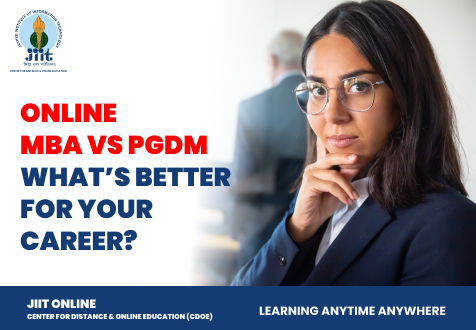
The digital learning revolution has completely changed the way employees acquire new skills and move forward in their careers, but traditional learning still plays a vital role. Online management courses, like an online MBA, have become extremely popular because they enable students to learn whenever they want, as the timetables are very flexible. On the other hand, a PGDM focuses on class-based learning, offering students face-to-face interaction with the faculty. As organisations and professionals increasingly focus on having the latest business skills and strategic thinking, a large number of aspirants are now leaning towards two very popular choices: an online MBA and a PGDM.
Often, it is the case that working professionals, fresh graduates, and career switchers compare these programmes so that they can decide which one fits better with their schedules, learning styles, and career goals. Essentially, both routes focus on developing high-level management skills; however, they differ in their format, level of recognition, and learning approach. In this article, you will find a comparison of these courses so that you can find out which programme is more effective for your career advancement.
Each programme helps in developing a learner’s management abilities; however, they are presented differently regarding their format, regulation and delivery of instruction. Knowing the differences between these two programmes will help you make a choice that fits your professional goals, how you prefer to learn and what your individual goals are.
| Parameter | Online MBA | PGDM |
|---|---|---|
| Qualification Type | A master’s degree granted by a university, holding formal academic status and long-term credential value | A professional diploma provided by AICTE-approved institutions, with a strong emphasis on skill development |
| Regulatory Authority | UGC-DEB regulated, thus maintaining compliance with domestic academic standards for postgraduate degrees | AICTE recognised with an emphasis on the curriculum keeping pace with the needs of the industry |
| Curriculum Design Philosophy | Structured around academic concepts, management theories, and strategic frameworks that support long-term leadership roles | Designed around industry practices, current business tools, and functional requirements of real workplaces |
| Depth of Management Knowledge | Gives a broad as well as a deep understanding of business operate at strategic and organisational levels | It mainly concentrates on specific functional areas and operational processes |
| Program Duration & Structure | Fixed two-year timeline with semester-based progression and defined academic schedules | Flexible duration of 1–2 years, often modular, allowing learners to progress at a faster or customised pace |
| Assessment Methodology | Relies on university examinations, graded assignments, presentations, and academic evaluations | Assessment is done through projects, live case analyses, presentations, simulations, and written examinations, with evaluation based on in-class participation and practical performance |
| Industry Exposure | Limited to moderate, often through capstone projects or internships depending on the university | High industry exposure through live projects, case studies, and workshops |
| Recognition & Career Mobility | Widely accepted across sectors and countries, supporting career mobility and higher education opportunities | Strong industry acceptance within India; international recognition depends on employer preferences |
| Admission Requirements | Requires graduation and may include entrance exams or university-defined eligibility criteria | Requires graduation with relatively flexible admission norms set by the institution |
| Cost Considerations | Generally higher due to degree status, university backing, and longer duration | Often more cost-effective, especially for learners seeking faster skill development |
Examining the curriculum in detail uncovers the nature of the learning experience each programme offers. An online MBA concentrates on enhancing one’s managerial knowledge by relating different business functions to the organisational strategy. Also, it is aimed at equipping decision-making, leadership, and analytical thinking skills.
In contrast, a PGDM focuses primarily on giving students hands-on experience through the use of industry tools and solving real-life problems. Both programmes address the core areas of business management, but they vary in the extent to which they incorporate applied learning, case studies, and project-based work.
| Aspect | Online MBA | PGDM |
|---|---|---|
| Core Management Subjects | Covers strategy alongside leadership, organisational behaviour, finance, marketing, operations, and analytics in a fully integrated manner | Focuses on functional management areas, operational processes, compliance, and core business practices |
| Analytical Skill Development | Equips learners to use data for strategic decision-making and facilitating long-term business planning | Prepares learners to leverage analytics tools for reporting, tracking, and facilitating the efficient functioning of operations |
| Leadership & People Management | Develops leadership thinking, team management skills, and organisational development capabilities | Builds leadership skills that are execution-oriented and mainly focused on supervision and coordination |
| Planning Orientation | Emphasises strategic planning aligned with organisational goals and competitive positioning | Emphasises operational planning based on immediate business needs and industry scenarios |
| Practical Exposure | There is practical learning, but it is mainly secondary to theoretical understanding | Practical learning is the focus, and there are numerous case studies, projects, and real-world simulations |
Considering the career outcomes of each course is important as both of the programmes open doors to management roles, but they both differ in the influence they have on your career growth.
| Aspect | Online MBA | PGDM |
|---|---|---|
| Nature of Job Roles | Prepares learners for managerial, leadership-track, and strategic roles within organisations | Prepares learners for executive, specialist, and operations-focused roles |
| Career Progression Path | Structured for gradual advancement into mid-level and senior management positions | Enables quicker entry into roles with steady growth through functional expertise |
| Consulting & Advisory Roles | Suitable for strategy consulting, advisory roles, and organisational planning positions | Suitable for implementation-focused consulting and process improvement roles |
| Skill Application in Roles | Applies conceptual knowledge, strategic thinking, and leadership judgment | Applies practical tools, systems knowledge, and operational execution skills |
| Career Switching Potential | Supports domain shifts by providing strong academic and conceptual grounding | Supports faster transitions by focusing on immediately applicable skills |
| Long-Term Growth Potential | Strong potential for leadership and senior decision-making roles | Strong foundation for early-career acceleration and functional specialisation |
It would become easier for you to choose one of the two courses if you align the programme with your personal goals, career stage, and preferred learning style. If you are eyeing leadership roles in the future and would like to have an internationally recognised qualification, an online MBA suits you perfectly. In contrast, if you are seeking work skills that are relevant to the industry and want to get a job quickly, then a PGDM is your best choice.
| Consideration | Online MBA | PGDM |
|---|---|---|
| Best Fit For | Learners aiming for long-term leadership, managerial authority, and formal academic credentials | Learners focused on gaining practical skills and entering or advancing in industry roles quickly |
| Learning Preference | Suitable for those who prefer structured learning, theory, and academic frameworks | Suitable for those who prefer applied learning, real-world examples, and hands-on practice |
| Career Vision | Ideal for strategic, leadership, and decision-making roles | Ideal for operational, specialist, and execution-focused roles |
| Program Structure | Fixed academic calendar with semesters and examinations | Flexible structure with modular progression |
| Qualification Value | Recognised as a master’s degree across industries and regions | Valued by employers for skills; degree equivalence may vary |
| Career Transition Support | Strong academic credibility for switching domains | Faster skill-based transition into new roles |
Both an online MBA and a PGDM are good educational options for the development of a successful management career, but they are meant for different professional necessities. An online MBA programme provides students with a comprehensive understanding of business, various strategies, and the ability to take up leadership roles. These are aspects for the progression of a career in the very long run. On the other hand, a PGDM is more directed towards theoretical aspects and skill development from the perspective of the industry to help students get a job in a shorter period. Your choice depends on your career goals, learning style and the kind of roles you want to take in the future.
Online MBAs are governed by UGC-DEB norms, ensuring degree validity across sectors. PGDMs, offered by AICTE-approved autonomous institutes, rely heavily on institutional reputation, industry tie-ups, and global accreditations for credibility.
Online MBAs emphasise continuous evaluation through quizzes, assignments, simulations, and proctored exams, while PGDM programmes focus more on classroom participation, presentations, group projects, internships, and in-person examinations.
Online MBAs from recognised universities are often more suitable for international equivalence and higher education abroad. PGDM recognition overseas depends on the institute’s accreditation, collaborations, and acceptance by foreign universities or employers.
The effectiveness of an online MBA largely depends on the learning management system, live faculty interaction, recorded content quality, analytics-driven feedback, and access to digital libraries, which directly influence skill development and engagement.
Online MBAs usually involve lower indirect costs such as relocation, accommodation, and opportunity loss. PGDM programmes may yield higher initial salaries, but total ROI varies based on fees, placement outcomes, and long-term career trajectory.