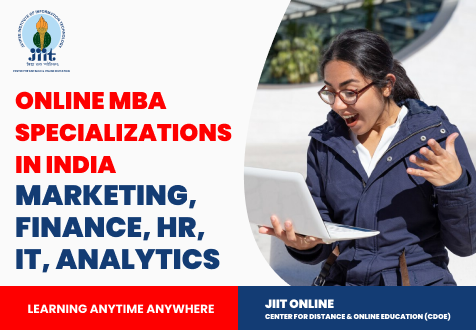
The management education paradigm of India has undergone an enormous transformation. Over the past few years, it has shifted beyond the “classroom versus computer” argument and entered into a phase of “elastic” leadership. In the coming days, the traditional concepts of “time” and “place” will no longer apply and instead will be replaced by the “hyperconnected,” digital world in which today’s online MBA course will provide a “live laboratory” for your professional life. The article examines how the various specialisations now defining corporate culture within India (including the impact of marketing technology and Business Analytics) play a key role in both the corporate hierarchy and your career path.
Today, marketing is about being the manager of the digital customer relationship. A recognised online MBA course in Marketing places a heavy emphasis on “MarTech” – the merger of Marketing and Technology. As digital ad spend in India is projected to exceed Rs. 50,000 crore for the fiscal year (FY) 2026, the contents of this curriculum have changed to reflect a focus on real-time data attribution and AI-driven consumer personas rather than the more traditional billboard advertising theories.
India has risen to become a global FinTech powerhouse, presently worth about $150 billion. As such, traditional Finance MBA programs have been disrupted and replaced with new study areas, including online mba courses focusing on educating students in the areas of digital payment architecture, blockchain for globalisation trade finance, and algorithmic risk management. With major Banking, Financial Services, and Insurance (BFSI) institutions such as ICICI and HDFC removing the stigma associated with an “online” designation from an MBA, this stigma is no longer a barrier for an individual seeking a trading position on Wall Street or any other trading floor worldwide.
The Human Resources Function transitioned from simply being an administrative overhead to an evolving role of Culture Architect, especially within a hybrid and remote work environment. Those pursuing an online Master’s in Business Administration program with a specialisation in HR Management are doing so using the same online tools to manage people that they will utilise after completing their degree. The emphasis has moved to Diversity, Equity, Inclusion (DEI), and to utilising the power of Talent Analytics.
Individuals working within Information Technology Management who complete an online MBA will bridge the gap between operational IT and executive-level IT leadership. The distinction of holding an online MBA in IT Management, rather than a traditional IT Degree, highlights an emphasis not just on technical skills, but also on the policies and procedures governing technology.
As many Indian corporations invest and introduce enhanced security and better technology to store and manipulate their information as part of modern infrastructure, there has never been a greater need for qualified IT Leadership that can communicate within both the technical community and the Boardroom.
In a rapidly growing industry, business analytics has become the most popular area of study for an online MBA. In India, national data analytics is expected to be worth $16 billion by 2026 end, and companies such as Accenture, Tata Consultancy Services (TCS), etc., have started hunting for managers who can create actionable predictive models from raw datasets.
Accreditation is the most important technical aspect when deciding on which online MBA course will be valid for your professional career. The best way to ensure that your online degree will be viewed as valid by potential employers is by understanding the “Equivalence Clause” within the UGC (Open and Distance Learning Programs and Online Programs) Regulations. According to these regulations, degrees earned from accredited online programs are equal to those received from traditional (on-campus) programs for all employment-related purposes, such as employment in Government Service.
It is mandatory to verify that any institution you are considering has received a minimum NAAC score of 3.26 or is listed in the top 100 of the NIRF University category.
All students must check the unique “DEB-ID” when registering on the UGC-DEB Portal; this process will prevent ‘fake’ degrees from being issued and will also guarantee that a student’s credits earned from their online degree program are transferable to other Indian-based institutions.
The average duration and layout of a typical online MBA course is two years, with four semesters. Students should be cautious about programs providing “fast-track” one-year degrees because, in many cases, they do not meet UGC requirements.
Choosing an MBA program via an online platform in the coming years should not just be seen as an opportunity for you to develop skills; it should also be viewed as an investment in your future. The specialisation that you select today could potentially determine your success in 2030, regardless of whether you are investigating consumer behaviour in Marketing, studying how Financial Technology (FinTech) impacts Finance, or creating a culture within Human Resources. In addition, the traditional way of working has disappeared and is now based on meritocracy, meaning you no longer have to work within a geographical area to earn a good income. Therefore, if you choose your area of study based on UGC-accredited institutions and the current high-growth areas, you will have the ability to manage your career through the uncertainty that will inevitably be part of a volatile global economy.
Be cautious when choosing distance learning programs from institutions that are not rated highly for placement rates or do not have a strong reputation as an institution with a good job placement record. Consider online finance programs from NMIMS or Symbiosis (which offer an aligned curriculum), as well as your full-time job and/or CFA Level I (self-paced). Such options offer a better return on investment compared to degrees that have not resulted in job placement.
The answer is yes if it is done for skill enhancement purposes and if the degree is a prerequisite for internal promotions, which are decided based on degrees. Then it would be better to choose short executive programs rather than cheap ones that lack rigour.
A Tier 1 school (IIMs/XLRI blended, expensive) is mainly for prestige and for people who want to switch their area of work; whereas Tier 2 (NMIMS/Symbiosis) is more for people who are already working and want to strike a balance between the return on their investment and their studies. Tier 3 (IGNOU) is for those who are looking for an affordable option, but without any chances of placements. Follow NIRF/UGC rather than reviews; do not expect to get a noticeably higher salary if you do not have access to alumni networks.
MBA Business Analytics will help you transition to HR Analytics by equipping you with the necessary skills, i.e., proficiency in the use of tools like Tableau and Power BI. The scope in the HR Industry (25% YoY Growth) is far greater than the pure HR, which is stable but with growth of only 10% yearly.