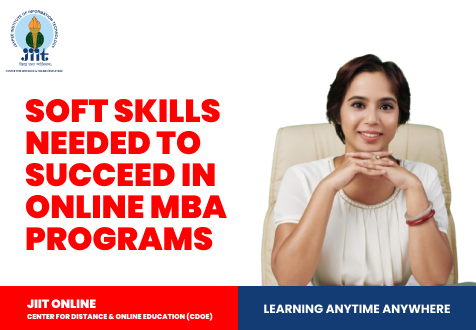
Today, the online MBA program surpasses the traditional in-person experience and provides a high-quality model for conducting business in the newly globalised and less centralised economic environment. As a result of the online MBA program providing an environment akin to that of working in an office regularly, many of the soft skills previously considered to be an accessory to the core knowledge needed to complete a graduate management degree are now viewed as the leading contributions to academic and professional returns on investment.
Success in the online MBA program requires much more than just being able to read numbers and graphs; it requires a complete overhaul of how we interact, manage, and lead ourselves and others through the Internet.
The flexibility of online MBA programs benefits students’ personal ownership over their schedules. But this is a double-edged sword. Students who succeed at online MBA programs will develop what experts refer to as “Temporal Sovereignty” – the ability to take control of their own internal timeline and to synchronise their work habits with those of a global cohort.
Students will need more than just to use a calendar app; they will need to create a mental on-ramp for deep-focused work despite the distractions of work and home.
Your digital footprint is built on the foundation of many keystrokes. Digital Articulation refers to one’s ability to take complex, strategic thoughts and express those thoughts in a way that is concise, persuasive, and empathetic. Due to the reliance of the online MBA program on both discussion boards and numerous forms of collaboration via Slack and shared documents, one of the most critical components of success within the online MBA program is successfully commanding a ‘virtual room’ via text. This ability is referred to as “Asynchronous Diplomacy,” which refers to your ability to give constructive criticism to your peers without the benefit of a smile or a supportive tone.
A significant hurdle in an online MBA program is the collaborative project that requires multiple high-performing, busy employees located on five different continents. In this case, typical “command and control” management strategies will not work. To successfully navigate this challenge, participants must use “Decentralised Orchestration” to connect the diverse team to a common objective.
Emotional Intelligence (EQ) is typically the aspect that gets lost first in digital communication. Without the help of physical cues, it becomes quite common to mistakenly think of colleagues as simply icons on a screen rather than as fellow human collaborators. Students have to build an “Empathy Engine” in themselves, which means that they have to get into the habit of constantly and proactively checking how the person behind the avatar really is.
AACSB Insights states that the ability to create and maintain inclusive environments has become one of the main criteria for the core accreditation standards, hence making EQ an essential feature of any MBA candidate.
Generative AI is radically changing the online MBA program. The future soft skill is Cognitive Agility, which is the capability to recognise when to use AI for work and when to use human intuition for the strategy. As mentioned in the 2024 GMAC Report, recruiters are becoming more and more doubtful of graduates who only “generate content”; they want those who can use technology to facilitate ethical reasoning and make good judgments.
The ultimate worth of an online MBA program is not really in the PDF of a textbook, but in the student’s personal growth journey. By effectively mastering temporal sovereignty, digital articulation, and decentralised leadership, you make the transition from a remote learner to a global leader. These soft skills happen to be the “hardest” ones to be automated and the most difficult to replicate. It safeguards that when you leave the digital classroom, you still have an invaluable, deeply human toolkit to enter the boardroom with.
Whether you are handling your first semester or making a choice between different programs, it is still a point to be remembered that the screen does not separate people; on the contrary, it is a filter that shows who really has the agility to lead in the age of intelligence.
It is beneficial to establish predetermined weekly plans in which study time before work/family is blocked. Moreover, micro-tasks can be performed with the assistance of an app like Todoist, and thus accountability partners from cohort forums can be used for the tracking of progress, which is close to the in-person rigour.
One should never lose sight of career goals and thus make use of quarterly reviews. Also, peer study groups on Discord/Slack can be used for virtual check-ins and milestone celebrations, such as module completions help in fighting isolation.
One needs to master the art of communicating through short emails/posts in discussion boards and, at the same time, record Zoom pitches for later listening to improve and adjust tone to global peers. These are the main points for remote leadership roles after graduation.
If we talk about networking and quick social adaptability, we can say that these are two skills one can only highly develop if they schedule LinkedIn coffees with alumni by role-playing negotiations in group projects and joining live webinars which are meant for improv practice.
It is the difference of being deliberately in control of one’s time rather than casually going to attending reactive lectures which is more typical of local universities; thus one has to focus primarily on tasks that generate most returns first (e.g., cases before readings) while using the Pomodoro (25-min bursts) technique to balance a job/life without the risk of getting tired.